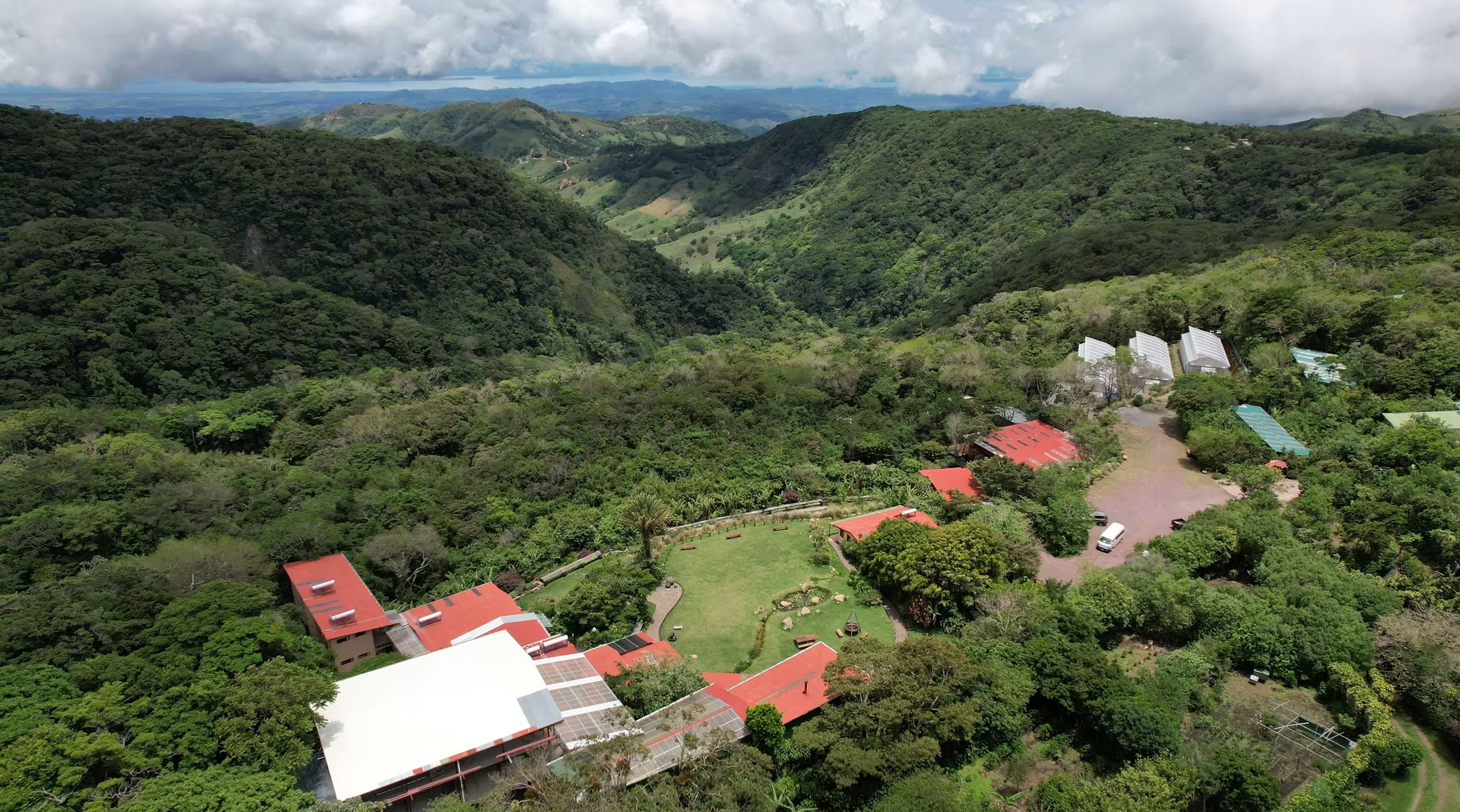
Costa Rica is one of the most ecologically biodiverse countries on the planet. It contains 6% of the world's biodiversity in 0.03% of its land area. It runs on over 99% renewable energy. It abolished its military in 1948 and redirected that funding to education and environmental protection. It is, by almost any measure, one of the best places on Earth to study sustainable living in practice — not just as a concept, but as a functioning reality embedded in culture, policy, and landscape.
For people looking for a serious, immersive sustainable living course, Costa Rica offers something that few other places can match: a context where ecological thinking isn't countercultural, it's the default. Where the forest is still intact. Where regenerative practices are happening at scale, not just in isolated demonstration projects.
Why Costa Rica for Sustainable Living Education
Choosing a location for an immersive course is a design decision in itself. Location is not neutral — it shapes what you can learn, what you can see, and what possibilities you can imagine. Costa Rica shapes the learning in specific, important ways.
Tropical biodiversity as a classroom. Most permaculture education happens in temperate climates. The tropics are where the majority of the world's population lives and where ecological degradation is most severe and most consequential. Learning sustainable design in a tropical context gives you directly applicable skills for the regions that need them most — Central America, South America, Southeast Asia, Africa.
A fully functioning regenerative farm.** Valle Escondido in Monteverde is not a demonstration project built for teaching. It's a working farm, lodge, and educational center that has been developing for over two decades. Students don't study a system built for them — they enter a living, producing system and learn by contributing to it.
Cloud forest ecology. Monteverde's cloud forest ecosystem is one of the most ecologically complex and biologically rich environments in the world. Learning water management, biodiversity integration, and ecological design in a cloud forest gives you a reference point for understanding ecological complexity that textbooks simply cannot provide.
"I've studied ecology in classrooms for years. Two weeks at Valle Escondido taught me more about how ecosystems actually function than all of that combined. There's something about being inside a complex living system — smelling it, hearing it, working with it daily — that changes how you understand ecology at a fundamental level."
— PDC graduate, Valle Escondido 2024
What the Sustainable Living Course at Valle Escondido Covers
AVER's Permaculture Design Certificate, held at Valle Escondido, is the primary vehicle for sustainable living education. It's a 72-hour intensive program structured across two weeks and covers the full PDC curriculum:
Week 1 — Foundations and Systems Thinking
The first week establishes the conceptual and analytical foundation. Students learn:
- Permaculture ethics and principles: Earth Care, People Care, and Fair Share — the ethical foundation of all design decisions
- Systems thinking and ecological design methodology: How to observe landscapes, analyze patterns, and develop designs that work with natural systems rather than against them
- Soil ecology and soil regeneration: Direct fieldwork in the Valle Escondido composting systems, biochar production, and living soil management
- Water systems design: Reading water flow in the landscape, designing swales and ponds, understanding watershed management
- Food forest design: Layer analysis, species selection for tropical food forests, the ecology of forest garden systems
All theoretical sessions are paired with direct field visits to working examples within the Valle Escondido system. Students don't just hear about food forests — they spend hours in them, learning to identify species, observe ecological relationships, and understand design decisions made years ago and their current outcomes.
Week 2 — Design Project and Advanced Topics
The second week shifts from learning to applying. Students work in small groups on a real design project for an actual client — a neighbor, a community organization, or a new section of the Valle Escondido property. This is not a simulation. The design is presented to a real client with real land and real needs.
Advanced topics covered in Week 2 include:
- Natural building: Earthen construction, bamboo structures, passive solar and cooling design — direct hands-on building sessions using materials from the property
- Integrated animal systems: Chickens, goats, and other animals as design elements — their role in fertility cycles, pest management, and system productivity
- Community and governance design: How the permaculture design methodology applies to human communities — decision-making structures, conflict resolution, and collective resource management
- Sustainable economics: How to design livelihoods, businesses, and economic systems based on permaculture principles rather than extraction models
Daily Life During the Course
Understanding what the day-to-day experience looks like helps you prepare and decide whether it's the right fit for your learning style and expectations.
The schedule is intensive but not punishing. Days typically run from 7am to 6pm with breaks for meals and integration time. Morning sessions are often theoretical, afternoons involve fieldwork. Evenings are informal — conversations continue, students work on designs, and the community that forms naturally over the two weeks deepens.
Meals are from the farm. A significant portion of the food served during the course comes from the Valle Escondido food systems — fresh vegetables, tropical fruits, eggs, and where possible, proteins from the integrated animal systems. Eating food produced in the system you're studying is itself a form of education about what a functioning sustainable food system actually looks like.
Accommodation is on-site. Students stay at the Valle Escondido lodge, immersed in the farm environment. This means learning happens beyond scheduled sessions — a morning walk through the food forest, an informal conversation with a farmer about a soil observation, an evening watching how bats and birds use the system. The learning doesn't stop when the classroom session ends.
One of the things we hear most consistently from graduates is how much they learned in the "in-between" moments — the conversations over meals, the walks between sessions, the questions that arise from just being present in a complex living system for two weeks. That ambient learning is only possible in a residential program.
What You Leave With
At the end of the two weeks, graduates receive the Permaculture Design Certificate — the internationally recognized credential that designates completion of the full PDC curriculum. This is the standard credential for permaculture practice worldwide, recognized by permaculture institutes and organizations across more than 50 countries.
Beyond the certificate, graduates typically leave with:
- A complete design project — a real permaculture design for a real site, developed and reviewed over the course of the program
- Practical technical skills — soil management, water system design, food forest planning, composting, and more, all practiced hands-on
- A design methodology that can be applied to any land, in any climate, at any scale
- A global community of PDC graduates who continue to share resources, collaborate on projects, and support each other's work
- A personal transformation in how you see landscapes — most graduates report that after the PDC, they cannot walk through any outdoor space without reading it differently, noticing patterns, water flows, and ecological relationships that were invisible before
Who Is This Course For?
The Valle Escondido PDC attracts a specific type of person. Not people who want a relaxing eco-tourism experience — this is an intensive educational program. The right participant is someone who:
- Is seriously interested in ecological design and wants professional-level competency
- Is planning to work with land — their own or others' — in a farming, design, or conservation context
- Wants to build a sustainable livelihood connected to ecological work
- Is ready for two weeks of intensive immersion in a field setting
- Values hands-on learning over theoretical study
Participants come from across Latin America, the United States, Europe, and Asia. Some are farmers. Some are urban professionals looking to change direction. Some are students. Some are educators. What unites them is a serious interest in ecological design as a lifelong practice, not just a weekend workshop.
How to Prepare
The course is designed for people without prior permaculture education — the PDC is a foundational credential, not an advanced one. No prior knowledge is required. That said, preparation is useful.
Before attending, we recommend reading Introduction to Permaculture by Bill Mollison or Permaculture: A Designer's Manual for deeper background. Reviewing our other blog posts on what permaculture is, soil regeneration, and the benefits of permaculture will also help you arrive with a useful conceptual foundation.
Physically, prepare for outdoor work in a tropical climate — comfortable field clothes, good boots, and the willingness to get dirty. Some sessions involve physical work in gardens and earthworks. This is not a desk-based education.
Taking the Next Step
AVER's PDC at Valle Escondido is one of the most complete permaculture immersion experiences available in Latin America. Two weeks in Monteverde, Costa Rica, inside a private nature reserve and working regenerative farm, with experienced instructors and a global community of fellow learners.
If you're ready to move from reading about sustainable living to actually learning how to design it, reach out to us to learn about the next cohort dates, costs, and application process. We're happy to answer specific questions about whether the program is a good fit for your goals.