Most people arrive at permaculture through a problem: degraded land, unsustainable food costs, a sense that the current system isn't working. They read about permaculture in theory — the ethics, the principles, the zones and sectors — and it sounds good. But what happens in practice? What are the actual, documented benefits of permaculture when it's applied to real land and real communities?
This article answers that question directly. The benefits are not theoretical. They've been measured on farms, documented by researchers, and experienced by practitioners across dozens of countries. Understanding them is important because permaculture requires investment — of time, learning, and energy — and that investment needs to be grounded in evidence, not just enthusiasm.
Benefit 1: Soil Regeneration and Long-Term Fertility
The most fundamental benefit of permaculture is what happens to the soil. Conventional agriculture depletes soil fertility over time, requiring ever-increasing external inputs to maintain yields. Permaculture does the opposite.
When permaculture design principles are applied consistently — no-till management, permanent ground cover, diverse plantings, composting, integration of animal systems — soil organic matter increases year over year. Studies from permaculture research farms in Australia and Europe show organic matter levels of 8–15% in established systems, compared to 1–3% in conventional fields. Higher organic matter means better water retention, higher biological activity, more nutrient cycling, and greater resilience to drought.
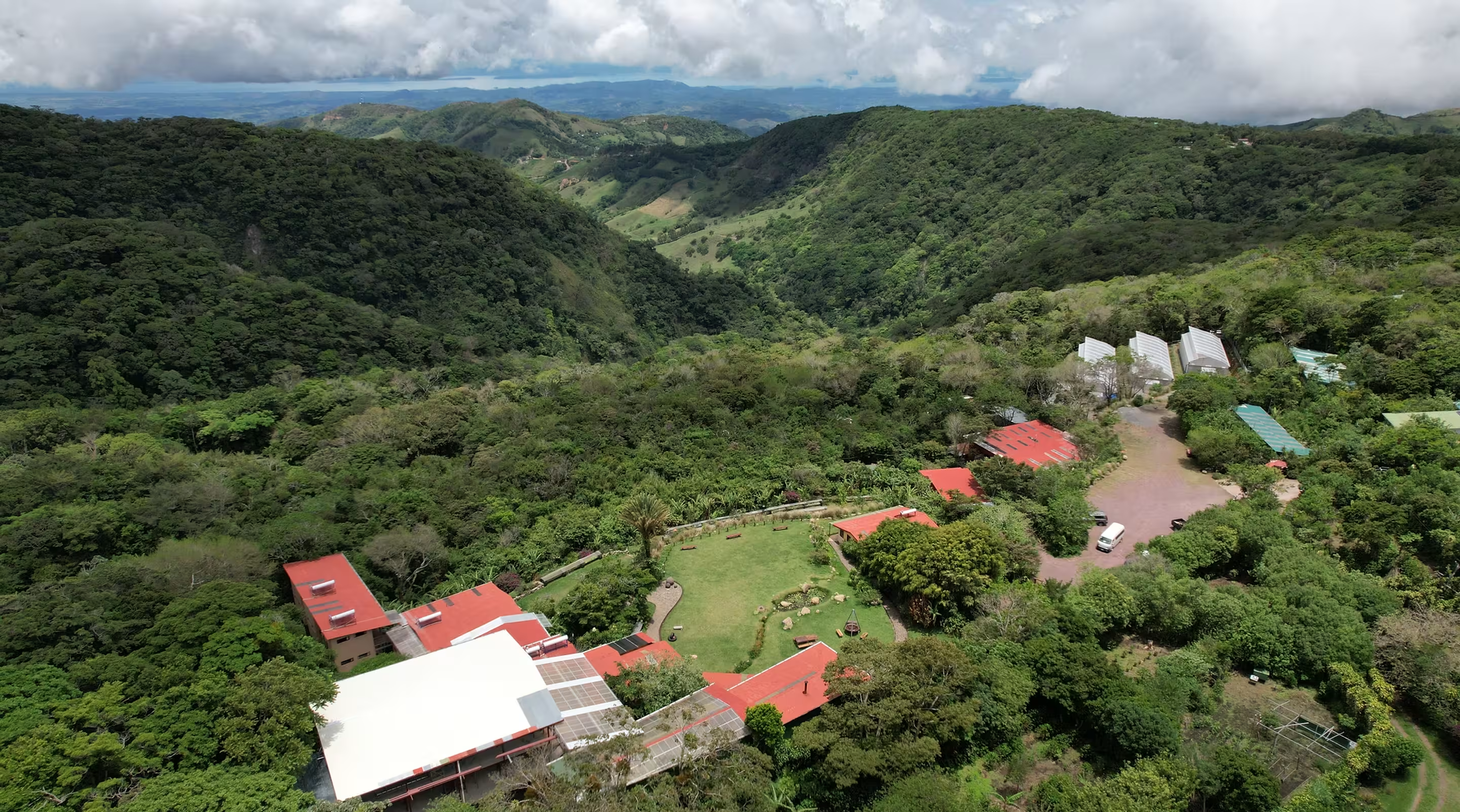
At Valle Escondido, areas that were compacted cattle pasture in 2003 now have rich, dark forest soil with earthworm populations exceeding 50 per square meter. The transition took approximately 8 years of consistent biological management — but the result is soil that now maintains itself without any external inputs.
For farmers, this translates into a concrete financial benefit: input costs decrease over time as the system becomes more self-sustaining. The investment in regeneration pays back in reduced dependence on purchased fertilizers, pesticides, and irrigation.
Benefit 2: Significantly Reduced Water Use
Water is the critical constraint in most agricultural systems, and one of the most dramatic benefits of permaculture is its impact on water use and water resilience. Well-designed permaculture systems typically use 40–70% less water than equivalent conventional systems producing the same food outputs.
This is not a small number. It's achieved through multiple integrated strategies:
- Swales and earthworks capture rainwater and direct it into the soil rather than allowing runoff — meaning less rain does more work
- High organic matter soils hold water like a sponge — each 1% increase in organic matter allows soil to hold approximately 170,000 liters more water per hectare
- Permanent ground cover prevents evaporation from bare soil, which accounts for 50–70% of water loss in uncovered systems
- Tree integration creates humid microclimates that reduce plant water stress and increase dew deposition
In regions where water scarcity is a serious concern — most of the tropical and subtropical world — the water management benefits of permaculture alone can determine whether a farm survives a drought year or fails entirely.
Benefit 3: Food Diversity and Nutritional Resilience
A permaculture food system produces a fundamentally different type of food security than monoculture agriculture. Instead of producing large quantities of a single crop (vulnerable to price collapse, disease, and market volatility), permaculture systems produce moderate quantities of many crops simultaneously — creating resilience through diversity.
At Valle Escondido, a single hectare of established food forest produces over 60 species of food plants simultaneously — fruits, vegetables, herbs, roots, greens, seeds, mushrooms — across multiple canopy layers. No single pest, disease, or weather event can destroy the entire harvest because no single crop represents more than 5–10% of total output.
This isn't just ecological resilience — it's nutritional. Diverse systems produce more complete nutrition. The narrow dietary base of grain-dependent populations is a leading cause of micronutrient deficiency worldwide. Permaculture food systems, with their abundance of fruits, vegetables, and diverse proteins, naturally provide broader nutritional coverage.
Benefit 4: Biodiversity — Ecological and Economic
One of the most well-documented benefits of permaculture is its impact on biodiversity. Farms managed with permaculture principles consistently show higher biodiversity — in plants, insects, birds, and soil organisms — than equivalent conventional farms. This is both ecologically important and practically valuable.
Ecologically, biodiversity provides the pest control, pollination, and nutrient cycling services that conventional systems replace with expensive chemical inputs. A farm with abundant beneficial insects has lower pest pressure because natural predators control pest populations. A farm with diverse flowering plants has better pollination rates. A farm with diverse soil biology needs fewer external fertility inputs.
Economically, biodiversity creates revenue diversity. A diverse permaculture farm has dozens of potential income streams rather than one. When the market for one product is poor, others compensate. When one crop fails, others succeed. This financial diversification is one of the primary reasons permaculture farms tend to be more economically resilient than monoculture operations.
"The best thing that ever happened to our farm financially was designing in more diversity. We stopped being victims of commodity prices and started operating more like a forest — always producing something of value, in every season."
— Common observation from farmers who transitioned to permaculture
Benefit 5: Drastically Reduced Input Costs Over Time
Conventional farming is an input-dependent model. Seeds, fertilizers, pesticides, fungicides, machinery, fuel — these costs increase every year while the commodity prices farmers receive for their products often stagnate. This structural trap is the leading cause of farm debt and farm failure worldwide.
Permaculture inverts this structure. The initial years require investment in design, earthworks, tree planting, and infrastructure. But as the system matures, external input requirements decrease. Fertility comes from the system's own biology. Pest control comes from biodiversity. Water comes from captured rain rather than purchased irrigation. Seeds come from saved varieties rather than purchased hybrids.
Research from permaculture farms in France, Australia, and the United States shows that farms in their 5th year of permaculture management typically have 50–80% lower input costs than equivalent conventional farms producing similar food volumes. The system has become self-sustaining in its most expensive dimensions.
Benefit 6: Carbon Sequestration and Climate Resilience
Permaculture systems are significant carbon sequesters. Trees, perennial plants, and healthy soils — all central to permaculture design — store carbon in biomass and soil organic matter. A well-designed permaculture farm can sequester more carbon than it emits, making it a genuinely regenerative system rather than a contributing factor to climate change.
This has practical implications beyond the climate benefit: systems with high organic matter and abundant tree cover are far more resilient to climate extremes — drought, flood, frost, and heat — than bare-soil conventional farms. The buffering capacity of complex biological systems is measurably higher than that of simplified industrial ones.
Benefit 7: Community Resilience and Knowledge Transmission
Permaculture's benefits extend beyond individual farms to the communities they're embedded in. Permaculture education — the PDC and related courses — transmits a body of ecological design knowledge that is increasingly rare in industrialized societies. Graduates understand how natural systems work, how to grow food, how to manage water, how to build community infrastructure.
Communities with a critical mass of permaculture-trained people are measurably more resilient in crisis conditions — they know how to produce food locally, manage resources efficiently, and organize collective responses to shared challenges. This is not abstract; it's been demonstrated repeatedly in communities that have navigated food disruptions, economic shocks, and natural disasters.
At Valle Escondido, over 500 PDC graduates from Costa Rica and across Latin America are now applying permaculture design in their own contexts — from urban gardens in San José to rural farms in Panama. Each graduate extends the reach of the knowledge network.
The Evidence Is Consistent
The benefits of permaculture are not based on ideology or wishful thinking. They're based on decades of documented evidence from farms, research institutions, and community projects across the world. The trajectory is consistent: permaculture systems become more productive, more resilient, and less dependent on external inputs over time — the opposite of conventional systems, which tend to degrade.
Understanding these benefits in theory is one thing. Seeing them in a working system — walking through a food forest, examining healthy soil, harvesting from a diverse system — is something fundamentally different. That's what the Permaculture Design Certificate at Valle Escondido provides: two weeks of direct experience with a system that has been developing for over two decades.
If you want to understand not just what permaculture is but what it actually produces, explore permaculture in practice with real examples, or get in touch to learn about our next PDC.