
The Problem: Degraded Land and Depleted Soil
Across the world, agricultural land is in crisis. Industrial farming has stripped nutrients from soil, depleted aquifers, and created deserts where forests once stood. In Costa Rica, the Caribbean coast — one of the most biodiverse regions on Earth — has seen thousands of hectares converted to monoculture banana and palm plantations. The damage is real, visible, and seems irreversible.
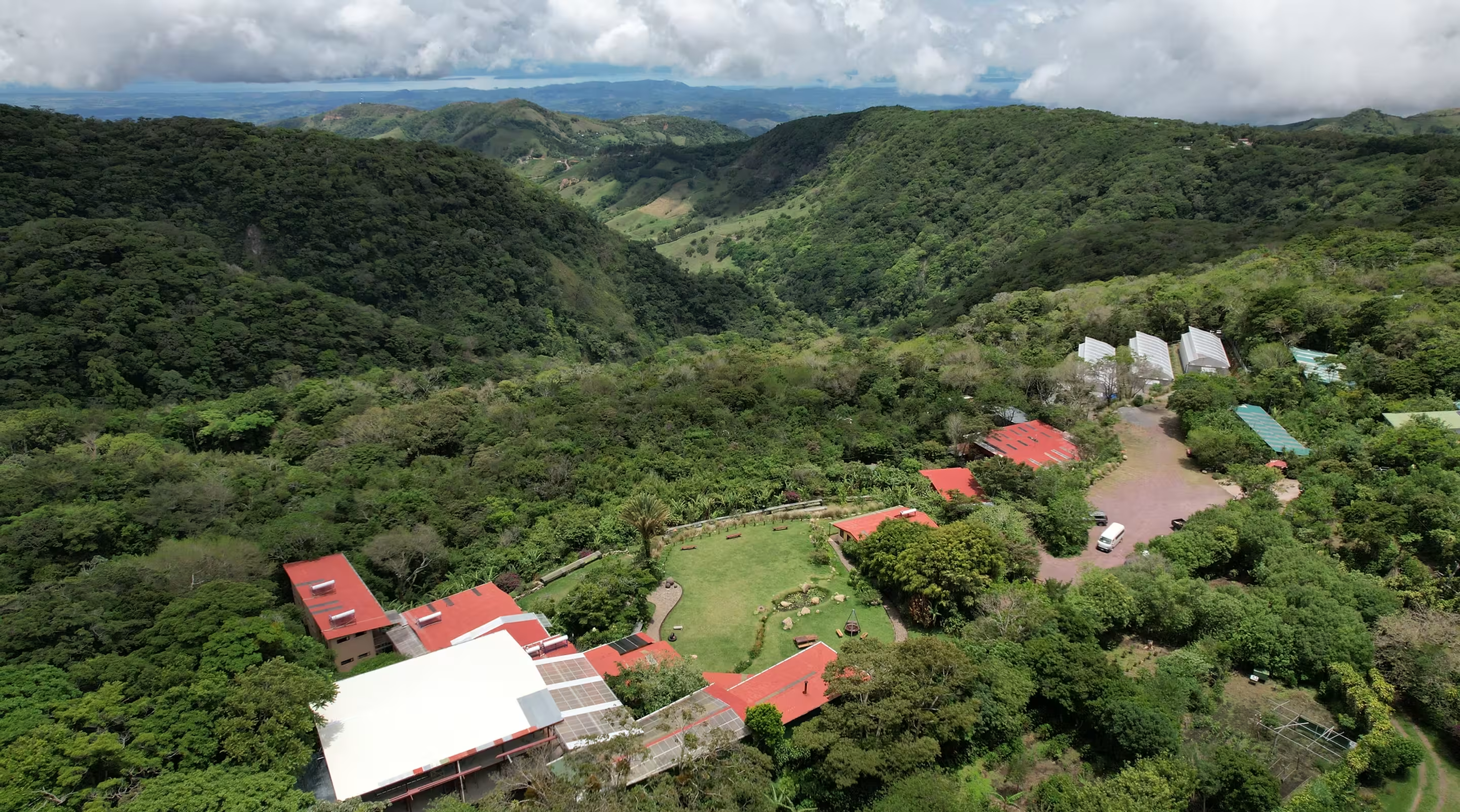
But there's a counter-narrative that most people never hear: land can regenerate. With the right approach, degraded soil becomes fertile again. Springs that dried up begin to flow. Food abundance returns. This isn't theoretical. It's happening right now at Valle Escondido, where 17 hectares of depleted tropical land have been transformed into a thriving, biodiverse permaculture system in just over a decade.
This guide covers the practical techniques used to make that transformation happen. These aren't complicated. They require patience, observation, and a willingness to work with nature instead of against it.
Start with Observation: Reading Your Land Like a Book
Before you plant anything, you need to understand what you have. The first principle of permaculture is "observe and interact." Most farmers skip this step. They see degraded land and immediately think, "I need to fix this." But the best designers spend months just watching.
At Valle Escondido, the design process began with an entire season of observation:
- Where does water flow during heavy rains?
- Where does it disappear? (These are drainage points.)
- What plants already grow there? (They're adapted to the conditions.)
- Where is the sun strongest? When?
- What winds do you get? From which directions?
- What's your soil actually made of?
- Is there any water source? How far below the surface?
This observation phase reveals patterns. It shows you where water accumulates naturally, where it runs too fast, where soil erodes. Once you understand the pattern, the design becomes obvious. You're not fighting the landscape anymore; you're working with it.
Water Management: Harvest It, Store It, Use It Wisely
Water is the limiting factor in most agricultural systems. Dry season ends production. Wet season floods destroy designs. The solution is to slow, spread, and sink water into the land.
Rainwater Harvesting Systems
At Valle Escondido, rooftop water collection is the beginning. But here's the critical detail most people get wrong: they collect it in plastic tanks and then pump it downhill. That's expensive, energy-intensive, and unsustainable. Instead, the design captures roof runoff and directs it into clay-lined ponds positioned strategically across the property.
These aren't artificial. They're designed to mimic natural water features. The clay lining prevents loss through seepage, and the ponds serve multiple functions:
- Gravity-fed irrigation to gardens below (no pumps needed)
- Water storage for the dry season
- Fish production (tilapia thrive in these systems)
- Evaporative cooling for nearby structures
- Habitat for amphibians and water-dependent insects
The cost is lower than concrete cisterns. The maintenance is minimal. And the system regenerates itself: the ponds gradually fill with sediment and organic matter, becoming more productive over time.
Swales and Keyline Design
On sloped land, the challenge is that water runs downhill too fast to infiltrate. The solution is a swale: a shallow, slightly sunken ditch that follows the contour line of the slope. Water flowing downhill hits the swale, slows down, and soaks in. Over months, this refills the water table. Over years, vegetation grows in the swale, stabilizing it and increasing water infiltration.
At Valle Escondido, swales were cut at multiple elevations. Below each swale, a row of fruit and nitrogen-fixing trees was planted. The trees benefit from the moisture, while their roots further break up compacted soil and allow water to penetrate deeper.
Gray Water Systems
Recycled water from sinks, showers, and washing machines shouldn't go to waste. At Valle Escondido, gray water is filtered through a constructed wetland — a planted basin where plants and microorganisms remove contaminants — and then used to irrigate ornamental and food-producing plants. This single system saves thousands of gallons of fresh water annually while improving soil health with nutrient-rich water.
Soil Building: From Dead Dirt to Living Ecosystem
Degraded soil isn't just infertile; it's dead. There's no life in it. The fungi, bacteria, arthropods, and earthworms that make soil function have been killed off by chemical inputs and bare ground. Rebuilding soil means restoring life.
Biochar and Activated Charcoal
One of the most effective techniques is biochar: charcoal made from agricultural waste through low-oxygen burning. Biochar is porous — at microscopic scales, it's riddled with tiny chambers. These chambers provide habitat for beneficial microorganisms while improving water retention and nutrient availability.
At Valle Escondido, agricultural waste (coconut husks, banana stalks, wood scraps) is converted to biochar. The biochar is then "activated" by mixing it with compost and EM-5 (a fermented microbial culture). Within weeks, it's colonized by microorganisms. When added to soil, it dramatically improves structure, water-holding capacity, and fertility.
Bokashi Composting
Traditional composting takes months and produces heat. Bokashi is faster and produces no odor. It works through fermentation: organic waste is layered with a bran inoculated with microorganisms, then sealed in a bucket. Within two weeks, the waste is broken down. It can then be added directly to soil or gardens, where it continues to break down and feed microorganisms.
Bokashi is ideal for kitchens, restaurants, and anywhere there's a steady stream of organic waste. At Valle Escondido, the restaurant produces bokashi from vegetable scraps, coffee pulp, and other food waste. This fermented material goes directly to the regenerative farm, feeding the soil ecosystem.
Vermicomposting and Native Microorganisms
Earthworms are the farmers of the soil. They consume organic matter and exude castings (worm poop) that are among the richest fertilizers known. Vermicomposting — raising earthworms in controlled environments — produces this "black gold" at scale.
Beyond earthworms, indigenous microorganisms are also critical. These are bacteria, fungi, and protozoa adapted to your specific region. At Valle Escondido, native microorganisms are cultured from the surrounding forest soil, multiplied in a fermentation process, and added to compost and soils. These microbes are more effective than any purchased inoculant because they're already adapted to local conditions.
Food System Design: Stacking Functions and Yields
Once soil is alive and water is secure, food production becomes efficient. But the key is to stack functions — to design systems where every component serves multiple purposes.
Food Forests and Agroforestry
A traditional farm has one crop per field. A food forest has dozens. The design mimics a natural forest: canopy trees (fruit-bearing), midstory trees (nitrogen-fixing and fruiting), understory shrubs (berries and herbs), ground cover (nitrogen-fixing and edible plants), and root crops. This vertical stacking produces massive yields from minimal space.
At Valle Escondido, the food forest includes fruit trees (mango, avocado, citrus), nitrogen-fixing trees (legumes, moringa), medicinal herbs, edible root crops, and perennial vegetables. A single hectare of well-designed food forest produces more food than several hectares of annual crops — with no need for chemicals, no tilling, and increasing productivity year after year.
Integrated Crop and Livestock Systems
Animals aren't separate from vegetable production; they're part of it. Chickens eat insects and weeds, while their manure builds soil. Goats clear brush that would otherwise become unusable. Fish in ponds control mosquito larvae while providing protein and fertilizing plants downstream. When integrated properly, livestock production and vegetable production support each other.
Aquaculture and Fish Ponds
At Valle Escondido, tilapia ponds are designed to be part of the larger system. Fish waste feeds plants. Plant material feeds fish. Aquatic plants grow in the ponds, providing feed and oxygen. The entire system is self-regulating and productive without external inputs.
The Timeline: Patience and Persistence
Regenerating land is not quick. Here's a realistic timeline based on Valle Escondido's experience:
Year 1: Design and observation, water system installation, initial soil building (biochar, bokashi, vermicompost), planting of perennial crops. Very little food production, but the foundation is being laid.
Years 2-3: Food forest begins producing. Annual crops in amended soil become productive. Water infiltration improves, and the land becomes greener. Microbial life in soil increases measurably.
Years 4-5: Polycultures mature. Productivity increases dramatically. Livestock is integrated. The system becomes nearly self-regulating.
Years 5+: Soil becomes darker, richer, more structurally sound. Water retention improves. Pest pressure decreases because predator populations establish. Food yields stabilize at high levels. Biodiversity increases visibly. The land is regenerating.
This isn't fast by industrial standards, but it's remarkably fast when you understand that you're rebuilding an ecosystem that took decades to degrade.
Scaling Up: From Home Garden to Farm to Region
These principles scale. Whether you have a backyard garden or a 45-hectare property, the fundamentals apply:
- Observe the water cycle first
- Capture and store water
- Build soil with living inputs
- Design systems where everything supports everything else
- Be patient
The difference is one of degree, not kind. A backyard with swales, biochar, and a food forest is a miniature version of Valle Escondido. A farm is a larger version. A region implementing these principles across many properties becomes ecologically regenerative and economically resilient.
Why This Matters: Beyond Your Land
Growing food sustainably isn't just about food. It's about water security, carbon sequestration, biodiversity, and community. Land that regenerates feeds the region, stabilizes climate locally, and supports wildlife populations. Regions with regenerative agriculture are more resilient to drought, flood, and economic disruption.
The techniques you've read about — biochar, bokashi, vermicompost, swales, food forests — these are implemented by farmers across Costa Rica and around the world. They work. They're proven. And they're available to anyone willing to learn and practice.
Learn Hands-On at Valle Escondido
Reading about these techniques is one thing. Working with them, seeing them work, understanding the underlying principles — that requires immersion. The Permaculture Design Certificate at Valle Escondido is a 16-day intensive course where you learn these systems by living inside one. You'll work with soil, water systems, and food forests alongside instructors who've spent decades refining these techniques.
If you're serious about regenerating land, growing food sustainably, or designing regenerative systems for your community, the PDC is where hands-on learning meets real-world application.


