Permaculture is Not Gardening
This is the first thing to understand. When people hear "permaculture," many imagine backyard vegetable gardens or small homestead farms. That's part of it, but it's not the whole picture. Permaculture is a design system for creating self-sustaining human settlements. It applies to land use, buildings, water systems, food production, energy, finance, governance, and community organization. It's as applicable to urban apartment blocks as it is to rural farms.
The word "permaculture" is short for "permanent agriculture" or "permanent culture" — the idea that human systems should be designed to last indefinitely, like natural ecosystems, rather than depleting resources and collapsing after a few decades.
The Origin Story: Bill Mollison and David Holmgren
Permaculture was developed in the 1970s by Bill Mollison, an Australian ecologist, and David Holmgren, his student. Both were observing the same problem: industrial agriculture was destroying soils, depleting water, and poisoning ecosystems. They asked a radical question: What if we designed agricultural systems based on how natural ecosystems work instead of fighting against them?
Mollison spent decades researching agricultural systems across the world — from traditional indigenous farming in tropical regions to temperate food forests in Europe. He documented patterns. He observed principles. From these observations, he and Holmgren distilled the core ethics and principles that became the foundation of permaculture.
Today, the Permaculture Design Certificate (PDC) — the internationally recognized credential for permaculture designers — teaches the full curriculum developed by Mollison and Holmgren. It's offered at permaculture schools worldwide, including at Valle Escondido in Costa Rica.
The Three Ethics: Earth Care, People Care, Fair Share
All permaculture design rests on three foundational ethics. These aren't rules; they're principles that guide every decision.
Earth Care
The land, soil, water, and all living systems are the foundation of everything. If the land degrades, nothing else is sustainable. Earth Care means designing to regenerate, not deplete. It means using practices that improve soil, restore water cycles, and increase biodiversity. At Valle Escondido, Earth Care guides decisions about water management, agricultural practices, and land use. The goal is for the land to be healthier at the end of the year than it was at the beginning.
People Care
Human needs matter. Food, shelter, health, education, and dignity are non-negotiable. A design that harms people is not permaculture, regardless of how "ecological" it appears. People Care means ensuring that designs meet human needs and contribute to human wellbeing. At Valle Escondido, this translates to fair wages for workers, nutritious food for all participants, safe living conditions, and education that empowers people to make better decisions.
Fair Share
Resources are finite. Fair Share means consuming only what you need and sharing surplus. It's not about deprivation; it's about conscious limits and equitable distribution. At Valle Escondido, Fair Share guides decisions about pricing (scholarships are funded by surplus from international participants), resource use, and profit distribution.
These three ethics create a simple test: Is this design improving the land? Is it meeting human needs? Is it fair? If the answer is yes to all three, you're on the right track.
The 12 Principles: A Design Methodology
The ethics are what permaculture cares about. The 12 principles are how you get there. They're not rigid rules; they're strategies used in nature that, when applied intentionally, create resilient and productive human systems.
1. Observe and Interact
Before you design, you must understand. Spend time on the land. Watch water flow. Note where the sun is strongest. Understand the local culture and history. The best designs emerge from careful observation, not from imposing an external plan onto the land.
2. Catch and Store Energy
Energy flows through every system — sunlight, wind, water, heat. Good design captures this energy and stores it for later use. Solar water heaters store sun energy. Ponds store water energy. Fertile soil stores energy from decomposing organic matter. Designs that waste energy will always be dependent on external inputs.
3. Obtain a Yield
The system must produce something valuable. If it doesn't, it will fail. At Valle Escondido, yields include food, water, materials, income, education, and wildlife habitat. Every element should contribute to at least one yield.
4. Apply Self-Regulation and Accept Feedback
Natural systems self-regulate. Predators control prey. Decomposers regulate nutrient cycles. Good design includes feedback mechanisms and regulation. If one element gets out of hand, other elements naturally constrain it. This is far more efficient than constant human management.
5. Use and Value Renewable Resources
Fossil fuels and mined minerals are finite. Renewable resources — sun, wind, water, biological productivity — are infinite (on human timescales). Good design prioritizes renewable resources for energy, materials, and inputs.
6. Produce No Waste
In nature, one organism's waste is another's food. There is no waste; there's only misplaced resources. In designed systems, "waste" should be redirected as input. Kitchen scraps become compost. Used water irrigates plants. Pruned branches become mulch or biochar. A system with waste is a failed design.
7. Design from Patterns to Details
Nature operates at scales from the microscopic to the planetary, with repeating patterns connecting them. Good design starts with the big picture — the pattern of water flow, the pattern of seasons, the pattern of energy input — and then designs details to fit those patterns. This is far more effective than starting with small details and hoping they'll fit together.
8. Integrate Rather Than Segregate
Diversity creates stability. Monocultures are fragile; diverse systems are resilient. Rather than creating separate zones for food, water, energy, and shelter, good design integrates them. Buildings provide thermal mass and wind protection for gardens. Gardens feed livestock. Livestock manure builds soil. Integration creates synergy.
9. Use Small and Slow Solutions
Big, fast changes create problems. Small, slow changes allow feedback and adjustment. Rather than clearing a large area and planting the same crop everywhere, better to develop small areas that can be observed and adjusted. Small and slow is often more productive and always more sustainable.
10. Use and Value Diversity
Diversity creates resilience. If 90% of your food comes from one crop and a disease wipes it out, you starve. If you have 20 different food sources, losing one is an inconvenience. Diversity of species, varieties, systems, and knowledge makes the whole more resilient.
11. Use Edges and Value the Marginal
Boundaries between ecosystems (forest/meadow, land/water) are among the most productive areas. More species variety, more productivity, more nutrients cycling. In designed systems, creating diverse edges — guild plantings, integration zones, transition areas — increases overall productivity and resilience.
12. Creatively Use and Respond to Change
Change is constant. Climate changes. Markets change. Technology changes. Rather than resisting change, good design responds creatively. The system should be flexible enough to accommodate change without losing function. This isn't about accepting whatever comes; it's about being resilient enough to adapt.
Permaculture vs. Conventional Farming
Conventional industrial farming is based on fundamentally different principles. Here's a comparison:
| Aspect | Conventional Farming | Permaculture |
|---|---|---|
| Soil | Tilled annually, depleted, requires chemical inputs | Built continuously, living, increasingly fertile |
| Water | Demands high input, runoff pollutes, aquifers depleted | Captured and stored, infiltrated, regenerates sources |
| Crops | Monoculture, genetically uniform, vulnerable to pests | Diverse polycultures, varied genetics, pest-resistant |
| Inputs | Fossil fuels, synthetic chemicals, genetically modified seeds | Solar energy, biological processes, local seeds |
| Pest Management | Chemical pesticides, kills all insects indiscriminately | Ecosystem design, encourages natural predators |
| Economics | Dependent on commodity prices, vulnerable to market crashes | Diverse income streams, resilient to market changes |
| Labor | Mechanized, few jobs, low wages | Skilled labor, many jobs, fair compensation |
| Sustainability | Unsustainable, depletes faster than regenerates | Regenerative, improves with time |
Conventional farming maximizes short-term production at the expense of long-term viability. Permaculture is the opposite: it sacrifices some short-term yield for long-term sustainability and resilience.
Permaculture vs. Regenerative Agriculture
Regenerative agriculture is a newer term that has gained traction recently. It has significant overlap with permaculture but some differences:
Overlap: Both focus on soil health, water cycling, and biodiversity. Both reject chemical inputs. Both recognize that agriculture should improve the land, not degrade it.
Difference: Regenerative agriculture is primarily focused on food and fiber production. Its goal is to regenerate agricultural lands. Permaculture is broader — it applies design principles to entire human settlements, including built environment, economics, governance, and culture. Regenerative agriculture says, "Let's fix farming." Permaculture says, "Let's design how humans live on Earth."
In practice, a regenerative farm is often also permaculture, and permaculture systems usually include regenerative agricultural elements. The terms are complementary.
The Permaculture Flower: A Framework for Design
The Permaculture Flower is a visual framework that organizes permaculture design into seven domains of human life. At the center are the three ethics. Radiating outward are seven "petals," each representing a domain:
- Land Use: How we arrange living and working spaces, food production, and natural areas
- Structures: Buildings and infrastructure designed for durability, health, and minimal environmental impact
- Tools & Technology: Appropriate technology that enhances human capability without creating dependence
- Culture: Social systems, education, and knowledge transmission
- Health & Spiritual Wellbeing: Individual and community health, mental wellbeing, and spiritual practice
- Finance & Economics: Money systems and economic structures that support Earth Care and People Care
- Governance & Community: Decision-making structures, laws, and community organization
A complete permaculture design doesn't just address one domain; it addresses all seven, recognizing how they interconnect. A design that has amazing food production but terrible governance, for example, will fail because community conflict will undermine everything else.
The Permaculture Design Certificate: Learning by Doing
Understanding permaculture intellectually is one thing. Actually designing and building permaculture systems is another. That's where the Permaculture Design Certificate comes in. It's typically a 72-hour intensive course (often spread over 10-16 days) where students learn the ethics, principles, and applications while working on a real design project in a real landscape.
At Valle Escondido, students spend two weeks immersed in a functioning permaculture system. They learn by doing: building swales, observing water flow, working with soil, observing food systems in action, and designing a complete permaculture site for a real client in the community. By the end, students don't just understand permaculture; they've practiced it.
Is Permaculture Practical?
Yes. Permaculture systems are functioning at every scale, from backyard gardens to regional networks to national programs. Examples include:
- Zaytuna Farm in Australia: A working demonstration permaculture farm that produces food, runs courses, and shows how the principles apply at scale
- The Greening Desert project in Jordan: Permaculture design transformed degraded desert into a thriving oasis
- Forest gardens in Kerala, India: Ancient permaculture-like systems still producing food and biodiversity
- Sepp Holzer's Krameterhof in Austria: A mountain farm that uses permaculture to produce diverse crops from high altitude
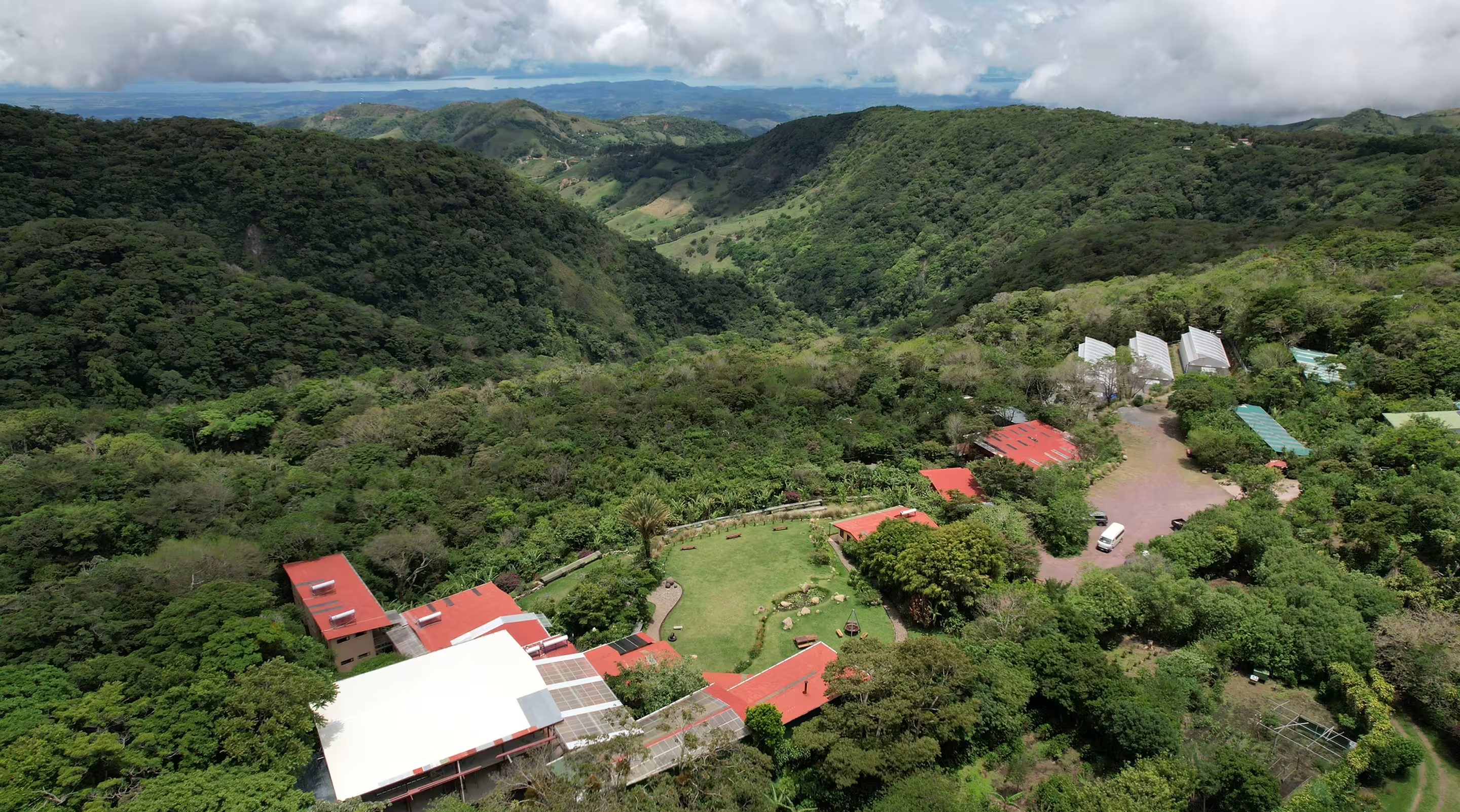
- Valle Escondido itself: 17 hectares of regenerated tropical forest with productive food systems, a hotel, a restaurant, and ongoing education
These aren't marginal successes. They're producing real food, real income, and real environmental regeneration while improving local ecosystems.
Why It Matters
We live in a time of ecological crisis. Climate change, soil depletion, water scarcity, and biodiversity loss are not theoretical problems; they're here and accelerating. Industrial agriculture contributes significantly to all of these. It's part of the problem.
Permaculture offers a practical alternative. It's not perfect, and it's not a complete solution to all problems, but it demonstrates that humans can live well on Earth while regenerating the land, water, and ecosystems we depend on.
Every person who learns and applies permaculture principles becomes part of the solution. Every garden designed according to these principles is a small regeneration project. Every farm is a larger one. And as these systems connect and expand, they create the possibility of a genuinely sustainable civilization.
Take the Next Step
If you're interested in learning permaculture — really learning it, not just reading about it — the next step is to find a PDC program. The Permaculture Design Certificate at Valle Escondido offers intensive, hands-on training in one of the world's most complete permaculture systems. You'll graduate with a globally recognized credential, real design experience, and the knowledge to implement permaculture on any scale.