Starting With Zone Design: Organizing Space Around Human Energy
One of permaculture's most practical contributions is zone design—a simple but powerful framework for organizing a property based on how intensively it's managed and how often it's visited. The zones radiate outward from the house like concentric rings, each serving a distinct purpose. Zone 0 is the house itself and immediate surroundings. Zone 1 is the closest area to daily human activity, typically 5-15 meters from the house. Zone 2 is farther out, visited several times a week. Zone 3 is visited occasionally, perhaps monthly. Zones 4 and 5 are rarely visited—zone 4 is lightly managed land (grazing, light harvesting), zone 5 is wilderness left to its own devices.
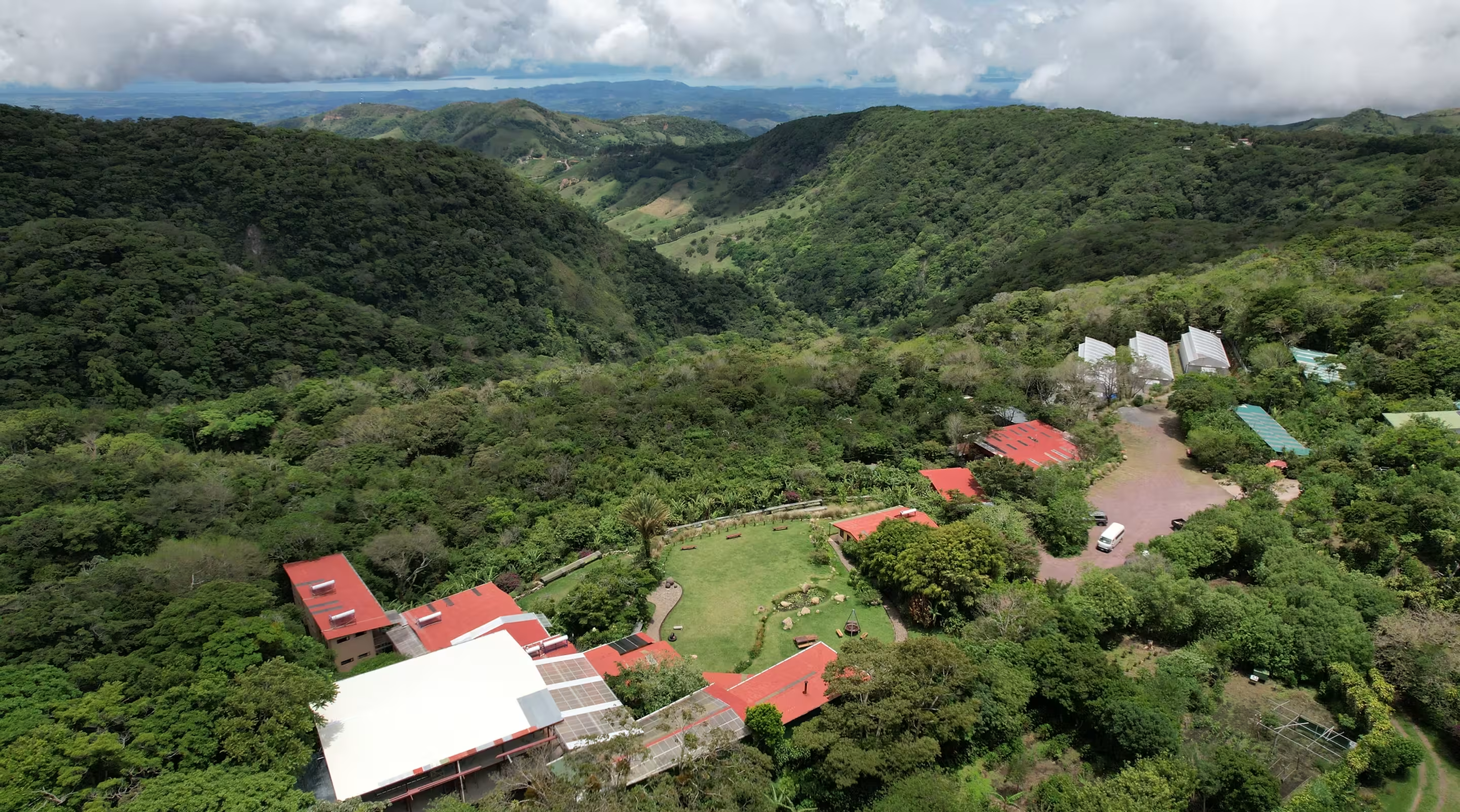
The logic is elegant: intensive inputs happen close to the house. Less intensive elements move farther out. This minimizes walking and work while maximizing the benefit of observation where it matters most. At Valle Escondido, Zone 1 contains the nursery and kitchen gardens where PDC students and farm staff spend time daily. These areas receive intensive attention and produce diverse vegetables, herbs, and propagated plants. Zones 4 and 5 encompass the old-growth forest reserve that surrounds the farm, lightly harvested for timber and medicinal plants, primarily left to develop as habitat and carbon sink.
The result is an organization of space that feels natural and efficient. Less walking, less work, more productive use of human time and attention. New visitors are often surprised by how much production happens in how little area, and how much time is freed by this basic organizational principle.
Food Forest: The Most Productive Ecosystem on Earth
A food forest is a multi-canopy system that mimics the structure of a natural forest but is composed almost entirely of species chosen for human food, medicine, or other benefit. Rather than monoculture rows of annual crops, a food forest has depth and complexity: multiple layers producing simultaneously, different plants peaking at different seasons, diversity that supports abundant wildlife, and a system that becomes more productive over time rather than depleting soil.
The seven-layer model is the standard framework: the canopy layer (tall trees like avocado, macadamia, breadfruit, native timber species), the understory layer (smaller trees like citrus, papaya, banana, cacao), the shrub layer (productive and medicinal shrubs), the herb layer (culinary and medicinal herbs), the root layer (tubers, potatoes, cassava), the vine layer (passion fruit, chayote, climbing beans), and the fungal layer (mycorrhizal networks and edible mushrooms in the soil).
Once established, a food forest is self-mulching (fallen leaves from the canopy cover the ground, suppressing weeds and building soil), self-fertilizing (nitrogen-fixing trees and plant matter decomposing in place create fertility), and mostly self-managing for pests (biological diversity creates natural pest control). The farmer's role shifts from cultivation to harvest, observation, and periodic pruning. Production increases year by year as the system matures.
A mature food forest shifts the farmer's role from cultivation to harvest, as the system becomes increasingly self-managing over time.
Valle Escondido's food forest took approximately five years to reach functional canopy coverage. Now, more than a decade later, it produces year-round with minimal external input: citrus, avocado, breadfruit, cacao, bananas, papayas, a rotating harvest of tubers, medicinal herbs, and foraged foods from the forest floor. It's used both as a food source and as a demonstration and teaching space—students walk through it learning to identify plants, understand layering, observe successional patterns, and imagine what their own land might become.
Aquaculture: Closing the Loop on Nutrients
At Valle Escondido, aquaculture—specifically tilapia farming in clay-lined ponds—is central to closing nutrient loops. Water enters the pond system from multiple sources: rainwater runoff, greywater from constructed wetlands, and vegetative matter from the food forest. Fish live in this water, feeding on duckweed and other aquatic plants that grow prolifically in the nutrient-rich environment. Their waste enriches the water further. When ponds are partially drained for maintenance and harvesting, the accumulated sediment—rich with nutrients from months of fish waste and decomposing vegetation—is transferred directly to garden beds where it acts as a powerful fertilizer.
This is the essence of "stacking functions": a single element—a pond—simultaneously solves multiple problems. It stores water for irrigation, produces protein (tilapia is delicious and nutritious), manages water quality through fish feeding, manages vegetation through aquatic plant growth, and generates fertility for gardens. Three or four problems solved by one intervention. The total input required from outside the system is minimal; instead, elements cycle and transform internally.
Water Systems: Harvesting and Distributing Without Pumps
Valle Escondido's hillside position enables one of the most elegant water systems possible: gravity-fed distribution from upper ponds and tanks to all lower growing areas. The system begins with rainwater capture—rooftop collection for domestic use, surface catchment in upper ponds. Water is stored at elevation. From there, main distribution lines run downslope using only gravity to create pressure. At branch points, simple shut-off valves direct water to specific zones. From mains, slow-flow drip lines deliver water directly to roots, minimizing evaporation and waste.
The entire system meets domestic needs (drinking, cooking, washing), irrigation requirements for kitchen gardens and food forest, aquaculture inputs, and even fire-suppression capacity—all from on-site rainwater capture. No pumps, no electricity, no dependency on external water systems. The system is resilient: if one element fails, others continue functioning. It's low-maintenance: no mechanical parts to break, no electricity costs. It's designed with the land's topography rather than against it.
The most elegant systems work with topography and gravity, requiring no pumps or external energy inputs.
Soil Building: Compost, Bokashi, Biochar, and Vermicompost
Valle Escondido doesn't just manage soil; it actively builds it. Rather than a single composting approach, the farm uses four complementary systems working in concert. Hot compost piles process kitchen waste, garden trimmings, and animal manures, reaching 60-70 degrees Celsius and killing pathogens in 60-90 days of active fermentation. This creates humus relatively quickly and is useful for large-scale fertility production.
Bokashi—a Japanese fermentation method—processes food waste including cooked food and meat (which hot compost typically cannot handle safely). This material ferments into a pre-digested form that, when buried in soil, accelerates soil biology and breaks down rapidly. Where hot compost is bulk-oriented, bokashi is kitchen-oriented and processes finer, more diverse waste streams.
Biochar is produced by pyrolysis—heating wood in low-oxygen conditions. The result is highly porous stable carbon with extraordinary surface area. Biochar incorporated into soil dramatically improves water retention, provides permanent habitat for beneficial soil microbes, and persists for centuries, making it a long-term soil investment. A small batch of biochar, properly activated (charged with nutrients), can improve soil structure and function for years.
Vermicompost uses red wiggler worms in bins to produce castings—concentrated plant-available fertility—and worm tea, an inoculant of beneficial microorganisms applied diluted to plants. Vermicompost is not as fast as hot compost, but it's more bioactive and creates finished product that's immediately plantable, unlike compost which continues decomposing after being added to soil.
Combined, these four systems produce more fertility than Valle Escondido consumes. The property is in net positive flow—improving soil quality year over year—rather than mining fertility from the land. Purchased inputs are essentially zero. This is what true self-sufficiency looks like at the most fundamental level.
Stingless Bees and Native Pollinators
Pollination is essential for any productive system, yet it's often taken for granted or assumed to be solved by honeybees. Valle Escondido cultivates Mariola bees—stingless bees endemic to Costa Rica—which have several advantages over European honeybees. They're perfectly adapted to the local climate and ecosystem. They don't sting, making them safe to manage around people. Their honey is distinctive and medicinal. Most importantly, they pollinate diverse local flora, supporting biodiversity while producing.
Supporting native pollinators requires deliberate action: planting for year-round flowering sequences so bees have consistent food sources, avoiding pesticides that kill beneficial insects, providing nesting habitat. At Valle Escondido, the biodiversity of pollinators visible on any given walk—not just Mariola bees but wasps, butterflies, beetles, and other insects—is strikingly greater than on nearby conventional land. This biological abundance makes the ecosystem more resilient: if one pollinator species has a bad year, others compensate.
Hugelkultur Terraces: Building Soil With Wood
Hugelkultur is a German technique for transforming steep or eroding slopes into productive garden terraces. The method works by cutting into a slope on contour, burying large logs horizontally along that contour, covering them with smaller wood (branches, twigs), then layering leaf litter, compost, and topsoil on top. The result is a raised bed that looks like a heavily mulched terrace.
Over years, the buried logs decompose slowly, serving as a sponge that holds water and as a long-term fertility source as organic matter breaks down. The structure also stabilizes the slope, turning areas that were erosion problems into productive growing zones. Year one might show slow growth as materials are still settling. By year three to five, hugelkultur beds become some of the most fertile, self-watering ground on the farm—tall production from humble materials.
At Valle Escondido, hugelkultur terraces step down steep hillside zones, creating planting beds while stabilizing the slope. They're built gradually as wood becomes available (tree pruning, fallen branches), making them essentially free to construct. The result is a system that builds itself over time: wood rots slowly, fertility accumulates, soil life flourishes, and productivity emerges from the integration of structure and time.
The Feedback Loop: How Each System Supports the Others
The true elegance of permaculture design emerges when you observe how these systems interconnect. Fish ponds receive water from the roof and from duckweed-growing basins fertilized by greywater nutrients. Fish waste fertilizes the pond water, which irrigates gardens through gravity-fed drip lines. Kitchen waste from the gardens goes to bokashi bins, which feed worm bins, which produce castings that feed the food forest. Fallen leaves from the food forest mulch garden beds, suppress weeds, and feed back into compost. Nitrogen-fixing trees on swale berms add fertility to the soil year after year without input.
This isn't a perfectly closed loop—some external materials arrive (people bring food waste and leaves), and some production exits (harvest). But the gap between what's produced and what's needed is minimal. Waste from one part becomes food for another. The system tends toward balance: more abundance in one area attracts more wildlife to manage it, diversity creates resilience against pests and diseases, fertility builds rather than depletes.
In integrated systems, waste from one part becomes food for another, creating a self-balancing ecosystem.
What You Learn by Living Inside These Systems
Reading about integrated systems in a book is useful; being physically present—tending worm bins daily, harvesting fish from ponds you helped design, walking swales after rain to observe water infiltration, eating a meal entirely from the land you live on—is something fundamentally different. The knowledge isn't just intellectual; it's embodied. You develop feel for healthy soil, recognition of when plants are stressed, intuitive understanding of what different plants need in different seasons.
Some knowledge lives in the hands and senses in a way that reading cannot convey. The smell of active compost. The feel of soil that's genuinely alive versus soil that's dead. The satisfaction of harvesting food you propagated and planted. The observation of how the system responds to intervention—how quickly a swale fills in heavy rain, how the water lens develops below the berm, how trees explode with growth once they tap into consistent moisture.
The Permaculture Design Certificate at Valle Escondido is structured precisely for this kind of learning. Students spend intensive weeks working in these real systems—not simulations or examples, but actual functioning ecology. They design interventions, implement them with instructor feedback, and observe the results. They leave with a certification and with knowledge that only comes from working with functioning land. If you're considering it, reach out through the contact page to start the conversation.