
In conversations about sustainable agriculture and ecological design, two terms keep appearing side by side: permaculture and agroecology. People use them interchangeably. They're often taught in adjacent courses. They draw from similar ecological traditions. But they are not the same thing — and understanding the difference matters, especially if you're deciding where to invest time and money in formal education.
This article lays out exactly what each field is, where they overlap, where they diverge, and how to decide which one to pursue — or whether both deserve your attention.
What is Agroecology?
Agroecology is the science of applying ecological principles to the design and management of agricultural systems. It's an academic discipline with roots in ecology, agronomy, and social science, developed primarily in research universities in Latin America, Europe, and North America from the 1970s onward.
Key figures in agroecology include Miguel Altieri, Vandana Shiva, and Stephen Gliessman — researchers who drew on indigenous agricultural knowledge and ecological science to critique industrial agriculture and develop alternatives. Agroecology is both a scientific discipline and a social movement, with strong ties to food sovereignty advocacy, peasant farming rights, and policy reform.
Agroecology operates at multiple scales simultaneously:
- The field level: How individual farms can be managed to maximize ecological function — diverse planting, natural pest management, soil biology improvement
- The landscape level: How farms interact with surrounding ecosystems — wildlife corridors, watershed management, biodiversity networks
- The food system level: How agricultural policy, market structures, and social systems can be reformed to support ecological farming
Agroecology is particularly strong on the policy and social dimensions that permaculture rarely addresses in depth.
What is Permaculture?
Permaculture is a design system for creating permanent, self-sustaining human settlements. It was developed by Bill Mollison and David Holmgren in Australia in the 1970s and is taught globally through the Permaculture Design Certificate (PDC) — a 72-hour intensive curriculum.
Permaculture applies design principles derived from natural ecosystems to human settlements in their entirety: not just food production, but housing, water systems, energy, economics, governance, and community organization. It's broader in scope than agroecology, extending beyond agriculture to all dimensions of how humans inhabit the Earth.
If agroecology asks "how do we farm in a way that works with ecology?", permaculture asks "how do we design everything — farms, houses, communities, economies — to work like an ecosystem?"
Permaculture is less academic than agroecology and more practitioner-oriented. Its primary credential — the PDC — is awarded by accredited practitioners and schools rather than universities. It's been criticized for this informality, but it's also produced millions of practitioners worldwide who have applied design skills in every possible context.
Where They Overlap
The overlap between permaculture and agroecology is substantial. Both draw on ecological science. Both emphasize diversity, soil health, natural cycles, and reduced dependence on external inputs. Both critique industrial agriculture. Both value indigenous and traditional farming knowledge. Both are explicitly about working with natural systems rather than against them.
In practice, a farm designed with permaculture principles will often look very similar to an agroecological system: diverse crops, cover crops, integrated animals, tree integration, water harvesting. The outputs — healthy soil, reduced inputs, food diversity — overlap significantly.
Many practitioners study both and draw freely from each tradition. The real-world results on farms often look identical regardless of which tradition the designer was trained in.
Where They Diverge
The differences become apparent when you examine scope, methodology, and institutional context.
Scope
Agroecology's primary focus is agriculture — food and fiber production systems. It excels at analyzing farm-level ecology and connecting that ecology to social and political food systems. Permaculture's scope is broader — it addresses not just food production but shelter, water, energy, economics, and community organization as an integrated design challenge.
Methodology
Agroecology is primarily analytical — it observes, measures, and studies existing and experimental systems to understand what works and why. It generates research, data, and evidence. Permaculture is primarily design-oriented — it provides tools and frameworks for creating new systems from scratch. Less research, more practical application.
Institutional context
Agroecology lives primarily in universities, research institutions, and policy organizations. A formal agroecology education typically leads to a degree — bachelor's, master's, or PhD. Permaculture lives primarily in communities, schools, and practitioner networks. Its primary credential (the PDC) is not a university degree but a professional certificate recognized within the permaculture community globally.
Cultural lineage
Agroecology has strong Latin American and Global South roots, with deep connections to food sovereignty movements. Permaculture originated in Australia and has a different cultural lineage, though it has been adapted globally and is practiced extensively in Latin America, Africa, and Asia.
Which Is More Relevant for Farmers and Land Managers?
For someone who owns or manages land and wants to improve it ecologically, permaculture's design-oriented approach is usually more immediately applicable. The PDC gives you a set of tools — zone analysis, sector analysis, design methodology, water management frameworks, food forest design — that you can apply immediately after completing the course.
Agroecology provides deeper scientific grounding and is more useful if you want to understand the research basis for ecological farming, engage with policy, or pursue an academic career in food systems. It's also valuable if your primary work is in social dimensions of food justice rather than direct land management.
The most capable ecological designers we've met have studied both. They have the design vocabulary and practical tools from permaculture, and the scientific depth and political analysis from agroecology. The two traditions complement each other far more than they compete.
What About Formal Education?
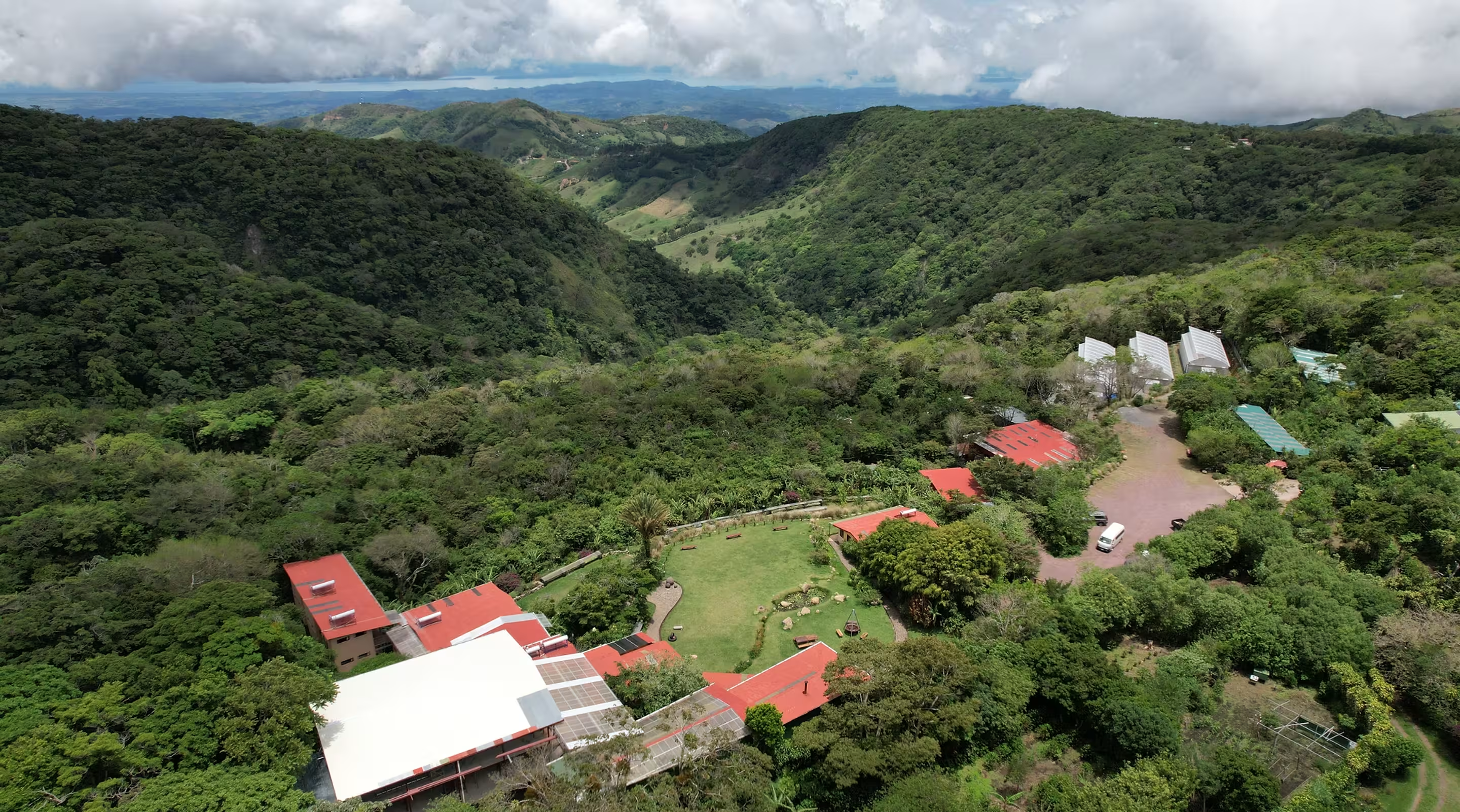
If you're looking for a short, intensive, practical course that gives you immediately applicable skills for land design, the Permaculture Design Certificate is the standard choice. It takes 2–3 weeks, can be done immersively at a farm like Valle Escondido, and provides a globally recognized credential.
If you want a university-level qualification in food systems, ecology, and policy, an agroecology program at a research university is the appropriate path. These programs range from short courses to full PhD programs.
Both credentials are respected in their respective communities. Neither is "better" in absolute terms — it depends entirely on what you want to do with the knowledge.
The Bottom Line: Use Both, Start with Design
The permaculture vs. agroecology debate is somewhat artificial. In practice, the most effective land managers and food system designers draw from both traditions. Start with permaculture if your primary goal is designing and implementing ecological systems on specific land. Add agroecological depth if you want to understand the science, the politics, and the broader food system context.
At Valle Escondido, the PDC curriculum draws from both traditions — teaching design methodology from permaculture alongside ecological science and social analysis from agroecology. The goal is graduates who can both design a working system and understand why it works.
If you're considering a permaculture education and want to understand what the PDC covers, read our guide to choosing the right permaculture design certificate, or reach out to us directly to learn about the Valle Escondido PDC.


