
What a Permaculture Design Certificate Actually Covers
The Permaculture Design Certificate has a clear heritage. It was originally defined by Bill Mollison, permaculture's founder, as a 72-hour curriculum. Despite decades of program variation, this minimum has remained surprisingly consistent across legitimate PDCs worldwide. Seventy-two hours is a real commitment—typically one to two weeks of intensive study—but it's the time required to meaningfully cover core material and complete a substantive design project.
The core curriculum includes these essential topics: permaculture ethics and the twelve design principles (the theoretical foundation); observation and site analysis (how to read your land); zone and sector analysis (organizing space and understanding influences); climate and microclimate (understanding local conditions); water management (harvesting, storage, distribution, treatment); soil ecology and building (the foundation of productivity); food forest and agroforestry design (productive multi-canopy systems); annual food production (vegetables, grains, annual crops); integrated animal systems (livestock, poultry, aquaculture); natural building principles (structures aligned with ecology); community and social permaculture (how to apply design principles to human systems); and a complete site design project (applying everything learned).
This final element—the complete site design—is critical. A PDC without a real design project is missing its core educational experience. In a legitimate PDC, you're not just learning concepts; you're applying them to a real property or detailed scenario, incorporating every principle, receiving instructor feedback, revising your design, and leaving with a functional blueprint (or portfolio) showing your competence in design thinking.
A legitimate PDC requires students to apply all principles to a complete site design project—the core element that transforms learning into competence.
Online vs In-Person: What the Evidence Actually Shows
This is where honest assessment matters. Online PDCs can be high-quality, comprehensive, and more affordable ($200-$800 versus $1,500-$3,000+ for in-person residential courses). They offer real advantages: you can learn at your own pace, access diverse instructors and case studies from around the world, avoid travel costs and time away from home, and often receive comprehensive visual and written materials you can reference long after the course.
Online courses excel at conveying theory and case studies. A well-produced online PDC uses video, animations, readings, and interactive exercises to make abstract concepts concrete. You can pause and re-watch complex sections. You can reference the material later. The cost is lower and accessibility is higher—you don't need to travel to a remote farm to learn permaculture principles.
But online cannot provide what in-person learning does: physical experience of real soil, water, and growing systems; sensory feedback (the smell of active compost, the feel of healthy soil, the visual chaos of a mature food forest); observation of real landscape conditions changing in real time; collaborative design work on an actual site where your choices have real consequences; and the informal learning that happens in meals, walks, and conversations embedded in a functioning permaculture system. You cannot learn the embodied knowledge—the feel for what works—entirely through a screen.
The strongest approach for most people: begin with an in-person PDC as your primary certification and deepest learning experience, then use online resources for ongoing education and specialized topics. The time and investment in residential immersion pays dividends in competence and confidence that extend across decades of application.
The 7 Criteria That Actually Matter
1. Instructor experience is foundational. Who is teaching, and what have they actually designed and built? Look for practitioners with real permaculture projects—farms they've designed and managed, water systems they've built, food forests they've established. An instructor who can point to a functioning 10-year-old permaculture system they designed carries credibility that a teacher working from curriculum alone cannot match. Experience also means making mistakes and learning from them; seek instructors who discuss failures and lessons, not just successes.
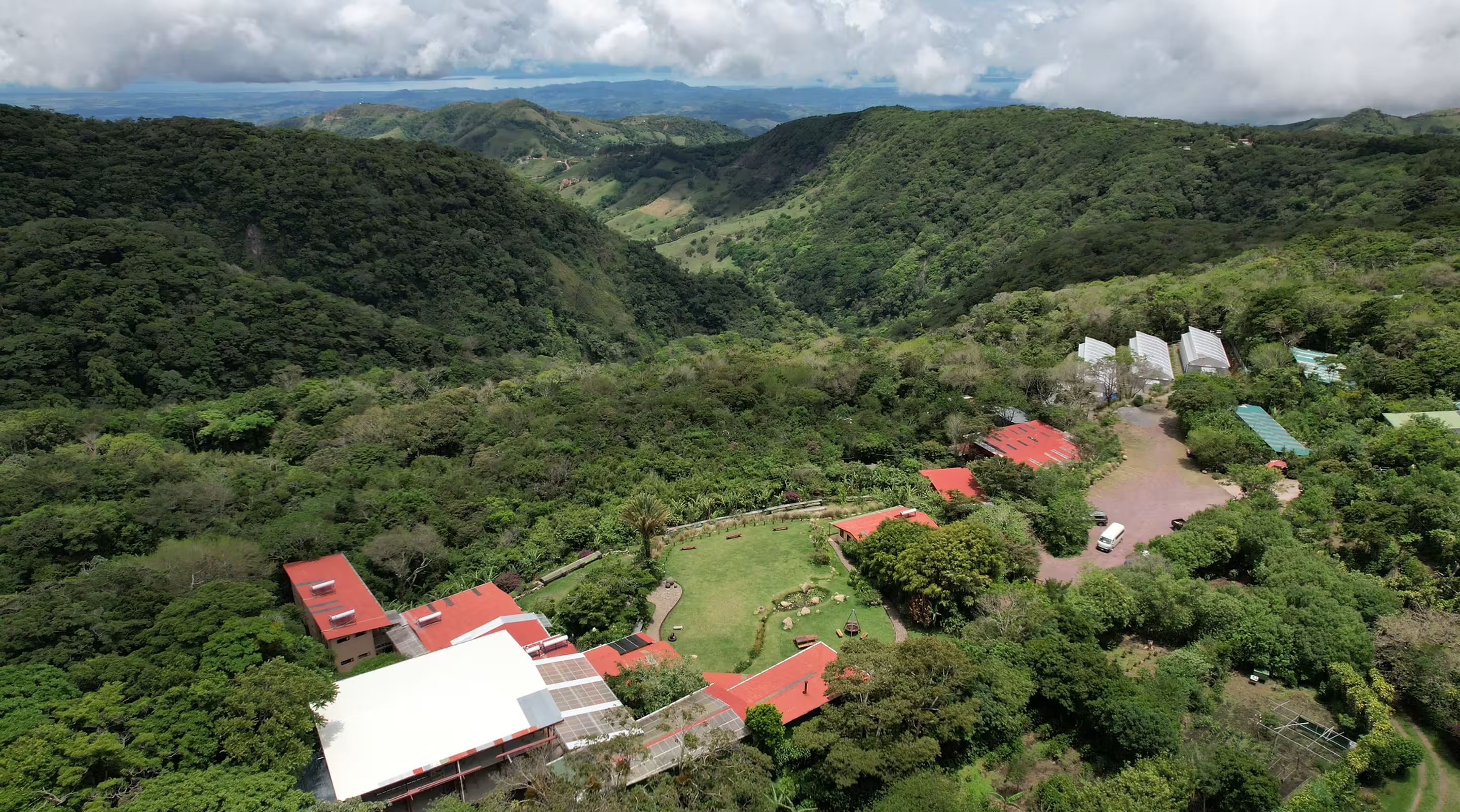
2. The site itself is the curriculum for in-person courses. A PDC held on a functioning permaculture farm is fundamentally different from one held at a generic conference center or university campus. The site is the teaching tool: you observe real water systems, walk established food forests, see soil building in action, notice how the property manages different zones and seasons. Valle Escondido as a site teaches things no instructor could convey through slides because the learning is ambient—the landscape itself is the text.
3. Time with real design work varies dramatically between courses. A program with only superficial design exercises teaches theory; a program with substantial design time teaches methodology and builds competence. Look for courses where you spend multiple full days with a real site (or detailed brief) and receive significant instructor feedback on your design. This is where you shift from understanding concepts to applying them—and this shift is where lasting learning happens.
4. Curriculum depth vs breadth makes an enormous difference. A course that spends an afternoon on water management versus one that dedicates three full days are fundamentally different experiences. Depth teaches understanding; breadth teaches what exists. Look for course descriptions that specify time allocation for each topic. A course that races through all twelve principles in a week might touch all bases but achieve genuine competence in none. A course that goes deeply into fewer topics builds real expertise.
5. Group composition and community shape the learning environment. Diverse practitioners—farmers, architects, environmental activists, business people, land managers—create richer learning through diverse questions and perspectives. Homogeneous groups (all farmers, all wealthy urbanites seeking escape) create different dynamics and less cross-pollination of ideas. Ask courses about typical cohort composition. Also ask about alumni networks: are graduates connected afterward? Is there ongoing community?
6. Post-course support extends the value significantly. What happens after you finish? Are there alumni gatherings? Online forums? Access to instructors for follow-up questions? Many participants struggle in the months after a PDC when they're trying to apply learning to their specific situation. Courses that provide ongoing connection—even loose connection—help bridge that gap. Some PDCs have established alumni networks and communities; others end when the course ends.
7. Transparency reveals commitment to genuine education. Be cautious of courses that promise everything or use vague marketing language. The best courses are specific about what they cover and what they don't, clear about time allocation, transparent about instructor qualifications, and honest about what students will and won't be able to do after completion. They acknowledge limitations: a PDC teaches design methodology, not mastery; it opens doors, it doesn't close them. You're becoming a designer, not a finished expert.
Red Flags to Watch For
A PDC without a design project is missing its defining feature. If a course description doesn't mention a substantial site design or design project, dig deeper. If it turns out that "design" means a worksheet exercise rather than a full design incorporating all principles, keep looking. The design project is where learning crystallizes—skip it and you're missing the core.
Instructors with no hands-on permaculture work themselves are a serious concern. If instructors can't point to farms they've designed, water systems they've built, or actual projects they've managed, question how they understand the practical dimension. Teaching from textbooks about permaculture is different from teaching permaculture from lived experience. Both have value, but the weighting matters.
Vague curriculum should raise suspicion. A schedule that reads as a general topic list ("Day 1: Principles, Day 2: Water, Day 3: Soil") with no specifics suggests the course may lack depth. Detailed course descriptions specify what will be covered and what time each topic receives. This transparency helps you assess whether a course matches your needs.
Groups larger than 25-30 students make individual feedback on design work difficult. In a PDC with forty students, you might get an hour of instructor feedback on your design; with fifteen students, you might get four hours. That difference is significant. Ask courses about student-to-instructor ratios and how individual feedback on design is provided.
A PDC conducted entirely online or in a classroom without connection to real land misses a dimension that can't be replicated. If you're choosing an online course (which has legitimate advantages), be clear about what you're gaining and what you're missing. If you're paying premium prices for in-person, expect to spend substantial time on real land learning from functioning systems.
Online courses gain accessibility and affordability, while in-person courses on functioning farms provide embodied knowledge that shapes decades of practice.
The Difference Between a Course and an Immersion
Some PDCs are organized as part-time programs—one weekend per month over several months, or evening classes during the work week. These have advantages: you don't need to take two weeks off work, cost is often lower, you stay rooted in your community. They also have real limitations: learning is fragmented, connections between concepts are harder to maintain over months, community building among cohort members is minimal.
A residential immersion where you're living on the farm for the duration of the course is a fundamentally different experience. Learning doesn't stop when formal sessions end. Dinner conversations continue the day's themes. A walk to water a garden bed becomes a learning moment. Rain events become curriculum. You observe how the farm actually operates daily, not just during teaching hours. You build deep relationships with instructors and fellow students.
At Valle Escondido, the PDC is residential—students live on the farm property for two weeks. The pond is outside your window, the food forest is where you walk to breakfast, the compost you contribute to daily becomes visible fertility. This ambient learning, combined with structured teaching, creates a depth of understanding that part-time or online programs can approximate but not replicate.
Who Should Take a PDC (and Who Should Wait)
A PDC is valuable if: you've genuinely decided that permaculture is a framework you want to understand deeply; you're planning to manage land in a significant way; you're in a related field (architecture, landscape design, ecological restoration, urban planning) and want to integrate permaculture thinking; you want to make a professional or lifestyle transition toward land-based work.
Consider waiting if: you're still uncertain whether permaculture is the right framework for you; you have no land context yet and are looking for general sustainability education (start with books and short courses); you're fundamentally looking for a life change quick fix rather than engaging in real learning; you're financially stretched—a PDC is a genuine investment and shouldn't strain your resources.
The ideal PDC student is curious, willing to work, committed to the learning process, realistic about what an intense two weeks can and can't accomplish, and has some sense of how they want to apply it afterward. A student asking "How do I design my property?" is in a better position than one asking "Will this teach me everything I need to know?"
Questions to Ask Before You Enroll
Get specific answers to these questions from any PDC program you're seriously considering:
• Who are the lead instructors, and can you see examples of their permaculture work (photos, descriptions, or references)?
• What is the ratio of teaching time to hands-on design work? How many hours do students spend on their design project with instructor feedback?
• What is a typical class size, and what is the instructor-to-student ratio? How are individual design projects reviewed and critiqued?
• Is the course residential? If in-person, how much time is spent actually on the farm versus in classroom settings?
• What systems are actively running on the property, and will students work in them? (It matters whether you're learning about aquaculture or actually managing ponds.)
• What post-course resources or community access is included? Are there alumni networks, follow-up sessions, or ongoing support?
• What have graduates gone on to do? Can you speak with alumni about their experience and how it affected their practice?
A program that welcomes these questions and answers them directly—without vague marketing language or evasion—is a program worth taking seriously. If you're considering the PDC at Valle Escondido, we're happy to answer each one with specific detail. Visit the contact page or schedule a call with an instructor to have this conversation directly. The right educational program should be clear about what it is and what value it offers.


