The number of online permaculture courses has grown significantly over the past five years. You can now find PDC-level content from dozens of providers at a fraction of the cost of an in-person program. For someone curious about permaculture design, this is genuinely good news — access to knowledge is wider than ever. But the question of whether an online permaculture course actually delivers what an in-person program does is worth examining carefully before you invest time, money, or expectations.
This guide gives you an honest comparison. We'll look at what each format delivers, where each falls short, and how to decide based on your specific goals — not based on marketing.
What Online Permaculture Courses Do Well
Online permaculture courses have real strengths, and dismissing them entirely would be unfair. The best online programs deliver:
Theoretical foundations at your own pace. The conceptual content of permaculture — the ethics, the 12 principles, zone and sector analysis, water management theory, soil science — can absolutely be taught effectively online. Video lectures, illustrated guides, and interactive exercises are well-suited to this type of content. For someone who wants to understand permaculture intellectually before deciding whether to pursue further training, an online course is an efficient and affordable entry point.
Access without geography or cost barriers. Not everyone can afford to travel to Costa Rica or Australia for a 2-week residential course. Online programs bring permaculture education to people who otherwise couldn't access it — in developing countries, in remote locations, or simply with financial constraints that make a residential program impossible right now. This democratization of access is genuinely valuable.
A community of learners. The better online programs build learning communities through forums, live sessions, and group projects. These communities can be genuinely supportive and educational, particularly for people in geographic areas where permaculture is not yet common.
What Online Courses Cannot Deliver
This is the critical section — and it's where honest assessment matters most.
Embodied knowledge of ecological systems
Permaculture design is fundamentally about reading and responding to real landscapes. You cannot learn to read soil by watching a video about soil. You cannot learn to identify water flow patterns from a diagram. You cannot understand what healthy forest ecology feels, smells, and sounds like from a screen.
The core competency of a permaculture designer is observational literacy — the ability to look at a piece of land and understand what it's telling you. This is developed through thousands of hours of direct observation, guided by experienced mentors who can point to what you're seeing and explain its significance. Online courses cannot replicate this.
We've had students arrive at the Valle Escondido PDC who completed a comprehensive online PDC before attending. Universally, they report the same thing: the conceptual framework they built online came to life in the first day of field work in ways that months of online study hadn't approached. The hands-on experience didn't just add to what they knew — it transformed how they understood everything they'd already learned.
Real design experience on a functioning system
The PDC's central exercise is the design project — students develop a complete permaculture design for a real piece of land. In an online course, this project is theoretical and self-assessed. In an in-person program, it's conducted on real land with real constraints, reviewed by experienced practitioners, and compared against dozens of other student designs.
The feedback loop of real-world design work is irreplaceable. When your design doesn't account for a prevailing wind direction, or places the water system below the garden it's meant to serve, or ignores a compaction layer that changes the entire drainage pattern — real land shows you immediately. Online land shows you nothing.
The immersive community experience
One of the most consistently cited benefits of in-person PDC programs is the community formed during the course. Students come from different countries, backgrounds, and contexts. They work together on designs, share meals, debate ideas, and build relationships that often last for years. Many PDC graduates cite their cohort as one of the most important professional and personal networks they've built.
Online courses can build community — but the depth of connection formed through two weeks of shared immersive experience is qualitatively different from forum discussions and video calls.
Who Should Choose an Online Course
Online permaculture courses make the most sense for people who:
- Are in an early exploration phase and want to decide whether permaculture is worth pursuing further without committing significant resources
- Have financial or geographic constraints that make an in-person program genuinely inaccessible right now
- Have a specific knowledge gap — water management, food forest design, soil science — and want focused study rather than a complete curriculum
- Already have significant hands-on farming or ecological experience and primarily need the design framework
Online learning works best as a complement to hands-on experience, not as a replacement for it.
Who Should Choose an In-Person Program
An in-person PDC is the better investment for people who:
- Are serious about applying permaculture design professionally or on their own land
- Want to develop genuine site reading and design skills, not just theoretical understanding
- Value the credential for professional purposes — working with clients, teaching, or developing projects that require demonstrated competency
- Are ready for an immersive experience that accelerates learning through full-time engagement
The Permaculture Design Certificate has always been designed as an immersive, hands-on qualification. The 72-hour minimum comes from an understanding that ecological design literacy requires direct experience with real systems. It can't be compressed into screen time — the medium matters.
The Hybrid Path: Use Both
The most effective approach for many people is to use online learning as preparation and follow-up for an in-person program. Before the PDC: study the conceptual framework — the ethics, principles, and design methods — so you arrive with a vocabulary and can engage more deeply from day one. After the PDC: deepen specific areas of interest with online courses, research, and community resources.
Several Valle Escondido PDC graduates have done exactly this: an online introduction, then the residential PDC, then continued online study in areas they want to develop further. The combination produces more capable practitioners than either format alone.
A Note on Certification Quality
Not all PDC certificates are equal — online or in-person. The quality of any PDC depends on the quality of the instructors, the curriculum depth, and the rigor of the design assessment. Before enrolling in any program, ask:
- Who teaches it, and what is their direct permaculture design experience?
- Does the curriculum meet the 72-hour PDC standard defined by Mollison?
- Is there a real design project component with genuine feedback?
- What do graduates say about the quality of the learning experience?
These questions apply equally to online and in-person programs. A bad in-person PDC is worse than a good online course. Quality matters more than format.
AVER's PDC at Valle Escondido: In-Person, Immersive, Real
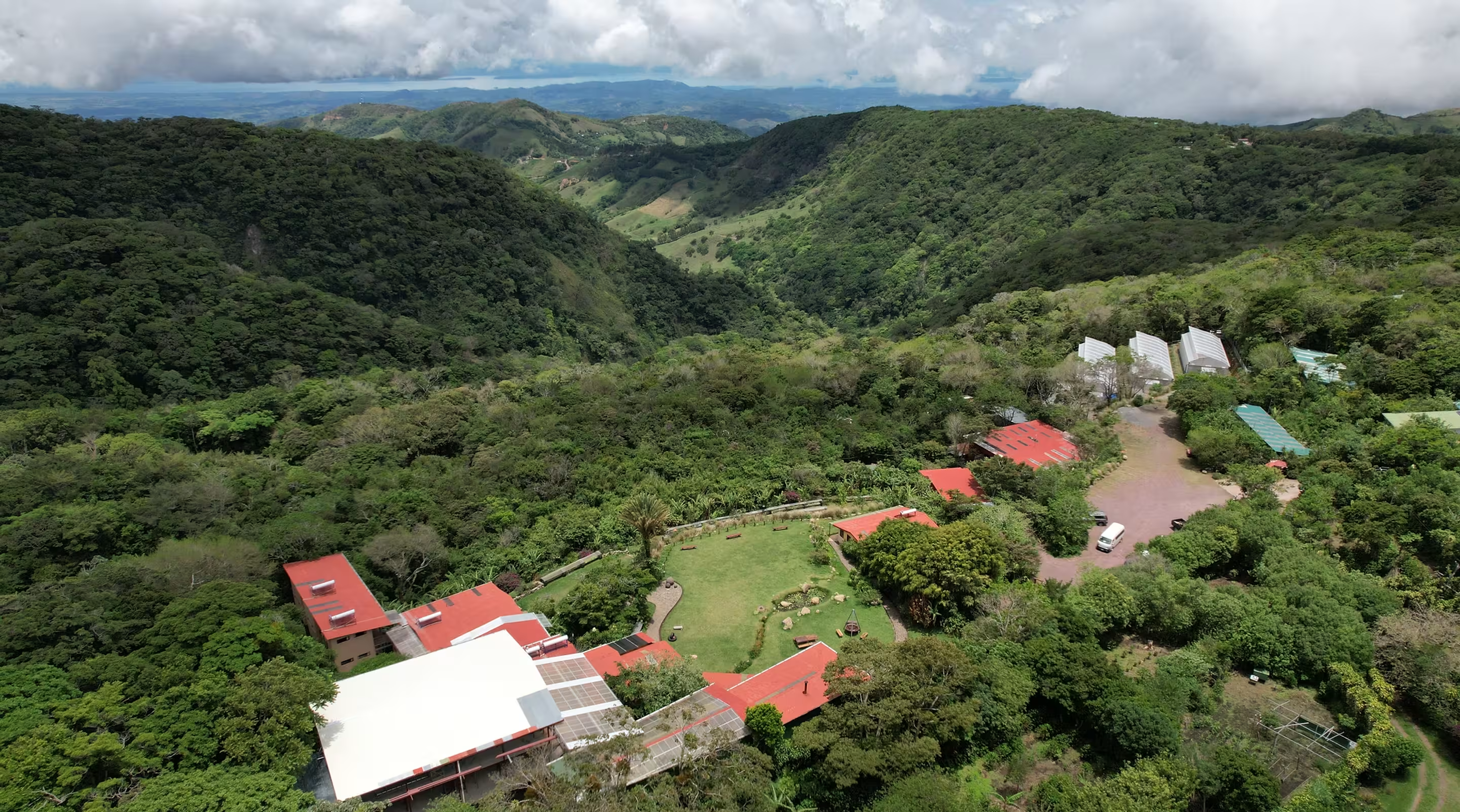
AVER's Permaculture Design Certificate at Valle Escondido is a fully residential, hands-on program held at a working 17-hectare private nature reserve in Monteverde, Costa Rica. Students spend two weeks living and working in a complete permaculture system — the learning is inseparable from the experience of being there.
The curriculum covers the full PDC standard: design methodology, soil and water systems, food forest design, integrated animal systems, natural building, and community design. Students complete a real design project for a real client in the Monteverde community and receive professional-level feedback from experienced designers.
If you're considering the next step in your permaculture education and want to understand whether AVER's PDC is the right fit, read our guide to choosing the right PDC or get in touch directly to ask about our next cohort.