Why These Two Keep Getting Confused
Walk into almost any conversation about sustainable farming, and you'll hear "regenerative agriculture" and "permaculture" used interchangeably. This happens partly because both movements emerged as responses to the same destructive reality: industrial agriculture's systematic degradation of soil, water, and ecosystems. Both are committed to building resilience rather than extracting resources. Both emphasize ecological health and long-term thinking.
But they are not the same thing. The confusion is understandable—they overlap significantly, share similar values, and even share practitioners. Yet they differ in scope, methodology, philosophy, and application. Understanding these differences clarifies which approach might work best for your specific situation, whether you're managing a farm, a homestead, or redesigning a food system. It also opens the possibility of integrating both frameworks rather than choosing one exclusively.
What Regenerative Agriculture Actually Is
Regenerative agriculture is, at its foundation, practice-based. It's a set of farming techniques designed to improve soil health, increase biodiversity, enhance water cycling, and sequester carbon while remaining economically viable at commercial scale. The core practices are well-documented: no-till or reduced-till planting to minimize soil disturbance, cover crops (planted between cash crops or seasons to protect and fertilize soil), diverse crop rotations to break pest cycles and balance nutrient demands, livestock integration (grazing animals both consuming vegetation and depositing nutrient-rich manure), composting and other organic matter management, and reduction or elimination of synthetic pesticides and fertilizers.
These are practical farming techniques that a large grain operation, a vegetable farm, or a ranch can adopt without fundamental redesign. A farmer producing commodity corn can transition toward regenerative corn production by implementing cover crops, reducing tillage, integrating livestock into the rotation, and cutting synthetic inputs. The infrastructure remains. The market structure remains. What changes is the underlying practice, the impact on soil and ecosystem.
Regenerative agriculture has institutional legibility. Universities teach it. Certification bodies define and verify it. Corporations adopt it. It's become mainstream enough that major food companies market products as "regeneratively grown." This mainstreaming is both a strength (widespread adoption) and a limitation (tendency toward greenwashing and minimized impact).
What Permaculture Actually Is
Permaculture is fundamentally a design system. It was developed in the 1970s by Bill Mollison and David Holmgren in Australia, explicitly as a response to the same industrial agriculture that regenerative agriculture now addresses. But where regenerative agriculture asks "How do we farm better?", permaculture asks "How do we design systems where the least input produces the greatest output? How do we mimic natural ecosystems while producing human needs?"
Permaculture operates from three explicit ethics: Earth Care (building soil, protecting forests, creating abundance), People Care (meeting human needs, building communities, creating fair distribution), and Fair Share (returning surplus to the system rather than hoarding). It then applies twelve design principles—observe and interact, catch and store energy, obtain a yield, apply self-regulation, use and value renewable resources, produce no waste, design from patterns to details, integrate rather than segregate, use small and slow solutions, value diversity, use edges and margins, creatively respond to change—to create integrated systems at any scale.
The power of permaculture is that it's not a practice toolkit; it's a methodology for thinking. You can apply permaculture principles to a quarter-acre urban garden, a farm, a ranch, a watershed, a community, or a bioregion. You can design buildings using permaculture principles. You can structure organizations using permaculture thinking. The framework is broad and adaptable to context.
Permaculture is a design methodology for thinking that can be applied at any scale, from urban gardens to bioregions.
Where They Overlap
The overlap is substantial. Both systems prioritize soil health—recognizing that soil is the foundation of everything. Both emphasize diversity—crop diversity, species diversity, diversity of income streams. Both reject monoculture and synthetic inputs. Both focus on cycling water and nutrients internally rather than losing them. Both aim to sequester carbon and restore damaged ecosystems. Both are founded on observation and evidence rather than ideology.
A farmer practicing regenerative agriculture is doing much of what permaculture suggests. A permaculture farm will likely incorporate every regenerative agriculture practice because they're effective and sensible. The overlap is real and important. Many practitioners fluent in both frameworks use them complementarily rather than in opposition.
Key Differences: Scope, Scale, and Philosophy
Scale is perhaps the most practical difference. Regenerative agriculture operates primarily at the farm or field level. Its improvements focus on how crops are grown, how soil is managed, how animals are integrated. Permaculture can operate at this scale, but it can also expand to whole properties, watersheds, and bioregions. A permaculture design might include the farm but also the buildings, water systems, energy production, waste cycling, and community structure surrounding the farm.
Approach differs fundamentally. Regenerative agriculture is practice-based: here are six proven practices, implement them as best fits your operation. Permaculture is design-based: understand the principles, observe your specific context, design a system from first principles to fit that context. This difference has consequences. Regenerative practices are easier to adopt because they're specified; permaculture requires more thinking and design but often produces more tailored, efficient results.
Ethics framework makes another clear distinction. Regenerative agriculture has implicit environmental stewardship values—it assumes we should heal soil and protect nature. Permaculture makes values explicit: Earth Care, People Care, Fair Share. This explicitness creates space for social, cultural, and justice dimensions that regenerative agriculture sometimes overlooks. Permaculture practitioners often engage with land rights, food sovereignty, and equitable access to resources because these values are embedded in the framework.
Compatibility with industrial systems differs. Large-scale commodity agriculture can integrate regenerative practices with minimal disruption. A thousand-hectare corn and soybean operation can adopt cover crops and reduce tillage while maintaining the same essential structure. Permaculture at scale requires more fundamental redesign—more perennials, more biodiversity, more human engagement—which is harder to achieve within industrial commodity frameworks.
Regenerative practices can integrate into industrial systems; permaculture requires redesigning the system itself.
Comparison Table
| Aspect | Regenerative Agriculture | Permaculture |
|---|---|---|
| Primary focus | Soil health and farming practices | Whole-system design across all elements |
| Scale | Farm / field level | Household to bioregion |
| Approach | Practice-based toolkit | Design methodology from principles |
| Compatible with commercial farming? | Yes — widely adopted at scale | Often, but requires more redesign |
| Includes social/cultural design? | Rarely — focused on farming practice | Yes — explicitly included |
| Ethics framework | Implied (environmental stewardship) | Explicit (Earth Care, People Care, Fair Share) |
| Primary learning path | Workshops, university programs, conferences | Permaculture Design Certificate (PDC) |
Permaculture vs Agroecology: A Third Framework
Before leaving this comparison, it's worth noting a third framework that sometimes enters these conversations: agroecology. Agroecology applies ecological science to agricultural systems, asking how we can design farms as functioning ecosystems rather than collections of inputs and outputs. In some ways, agroecology is more scientifically rigorous than permaculture, and more holistic in scope than regenerative agriculture.
Agroecology also carries dimensions that the other frameworks sometimes underemphasize: it's explicitly political and justice-focused, concerned with food sovereignty, land rights, and power dynamics in food systems. An agroecologist is likely to be concerned not just with how to farm well, but with who owns the land, who controls the seeds, who benefits from the system, and how to redistribute power toward peasant farmers and Indigenous communities.
A practitioner fluent in all three—understanding regenerative practices, permaculture principles, and agroecological thinking—is better equipped than one who knows only one. They're not in conflict; they're complementary lenses on the same fundamental challenge: how to feed ourselves and communities in ways that heal rather than destroy.
Which Is Better for Small Farms and Homesteads?
For most small-scale operations—homesteads, market gardens, small farms under 20 hectares—permaculture's design methodology offers more value than regenerative agriculture's practice toolkit. This is partly because the constraints are different. A small farm usually has irregular topography, limited budget for machinery, biological resources (trees, water, wildlife) that can be leveraged, and the possibility of multiple outputs from the same land. These conditions are exactly where permaculture design excels.
The regenerative agriculture practices—cover crops, crop rotation, livestock integration, compost management—are still central. But they're placed within a broader permaculture design that might include food forests, water harvesting systems, greywater processing, microclimates for specific crops, and functional stacking of elements. A permaculture approach at small scale usually results in higher productivity per unit area, lower labor requirements long-term, and greater resilience than either regenerative agriculture alone or conventional farming.
Which Is Better for Large-Scale Agriculture?
For large-scale commercial agriculture—1,000-hectare grain operations, large ranches, extensive orchards—regenerative agriculture has significantly more institutional legibility and practical tractability. Large-scale permaculture is theoretically possible and genuinely valuable, but requires more fundamental redesign of infrastructure, economics, and labor organization. Implementing cover crops across 500 hectares is complex but achievable; replanting 500 hectares into diverse perennial polycultures is a different magnitude of redesign.
That said, regenerative practices embedded in a permaculture framework—thinking systematically about how all the elements interact—can be more effective than regenerative agriculture done in isolation. Large-scale permaculture is emerging through projects integrating perennial crops, diverse grazing, water management, and ecosystem restoration across large areas. These are still relatively rare, but they demonstrate that large-scale permaculture is possible and often more productive than either conventional or regenerative monoculture.
How Valle Escondido Combines Both
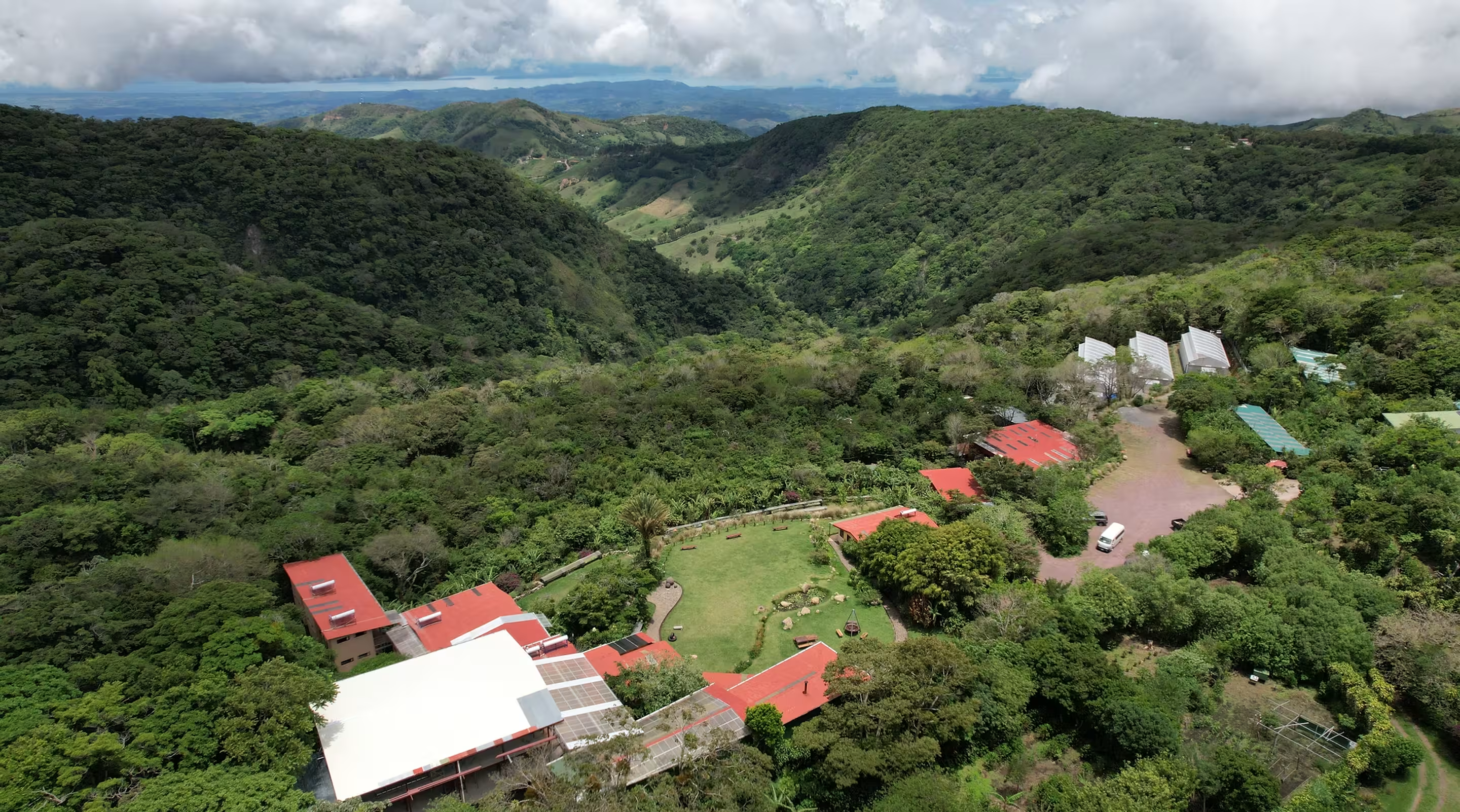
The framework at Valle Escondido is explicitly permaculture: the design started from first principles using zone analysis, sector planning, and integrated systems thinking. Water harvesting, food forest development, building placement, and management flows all follow permaculture design methodology. But the specific practices employed are drawn from the full sustainable agriculture toolkit: compost and vermicompost systems, biochar production and incorporation, bokashi fermentation, rotational grazing, aquaculture integrated with greywater processing, agroforestry with diverse tree species, and explicit cultivation of native species for ecological restoration.
This is pragmatic rather than ideological. We use regenerative practices because they work. We use permaculture design methodology because it creates systems more resilient and productive than isolated practices. We use agroecological thinking because it reminds us that food systems are embedded in social systems, and that justice matters. The result is a functioning system that produces food, builds soil, stores and cycles water, creates habitat, and demonstrates principles that students can learn from and apply in their own contexts.
For someone deciding which approach to explore deeper, consider: Are you primarily focused on optimizing a specific farming operation? Regenerative agriculture certifications and programs provide a clear pathway. Do you want to design a whole property or system from first principles? A Permaculture Design Certificate provides methodology and frameworks. Want to understand how to feed a community equitably while restoring land? Agroecology programs and networks are the entry point. Many effective practitioners move through all three, using the insights from each to deepen their understanding and expand their capabilities.