Why the Learning Site Is Part of the Curriculum
A Permaculture Design Certificate teaches principles—the ethics, the design framework, the tools for observation and analysis. These are vital and transferable to any context. But principles without context are abstractions. A swale is a conceptual tool until you stand in a real one after rain, watching water spread along the contour, observing where it infiltrates and where it pools. Then swales become tactile, visible, real.
"Observe and interact" sounds simple in a classroom. On a working farm, in a tropical ecosystem operating at full biological intensity year-round, observation is a daily practice with immediate, visible consequences. You observe water movement after rain, notice which plants thrive and which struggle, see how the forest edge differs from open garden, watch how the system responds to interventions you make. Every walk is a lesson. Every weather event is curriculum.
The richer and more diverse the site, the more every principle comes to life. Few environments offer richer systems than a tropical nature reserve managed for permaculture production for over a decade. Such a site allows you to learn permaculture not as abstract theory, but as living, functioning practice embedded in a landscape you can touch, smell, and work in daily.
The site itself becomes curriculum—principles transform from abstract concepts into tangible, observable reality through daily interaction with functioning systems.
The Tropics as a Living Classroom
Tropical and subtropical regions occupy roughly 40 percent of Earth's land surface yet support approximately 80 percent of the planet's estimated plant and animal species. This extraordinary biodiversity isn't incidental; it's central to why tropical systems are so productive and complex. More species mean more interactions, more functional redundancy, more resilience, and more abundance.
In temperate climates, where seasons compress biological activity into specific windows, the learning observation window is narrow. Cold winters kill most pests but also stop plant growth. Growing season lasts a few months. Soil organisms slow dramatically in cold. If you miss something in June, you might not see it again until next June. In tropical regions, particularly cloud forests, life operates at full capacity year-round. Interactions between species are continuous. Succession from bare ground to dense forest can be observable across a single property. Pests, pollinators, decomposers, and predators all operate constantly in visible, real-time cycles.
For someone learning permaculture design, this is an unmatched educational environment. You're not imagining how systems work in the tropics; you're inside them, observing them daily, testing your understanding against reality. This direct education in tropical ecology—the most productive and complex biome on Earth—fundamentally shapes how you design anywhere afterward.
Biodiversity You Cannot Learn From a Textbook
Costa Rica contains roughly 500,000 species—approximately four percent of all estimated species on Earth—concentrated in a country smaller than West Virginia. This density of biodiversity is extraordinary. More than half of the species found there are plants; thousands are insects; hundreds are bird and mammal species. The sheer abundance of life is visible, audible, and tangible.
The Monteverde cloud forest region where Valle Escondido is located is one of the most biodiverse areas within one of the most biodiverse countries on Earth. Cloud forest ecology is distinctive: persistent low clouds create an exceptionally moist microclimate supporting species found nowhere else. Plants, animals, fungi, and microorganisms have evolved in relationship to these conditions over millennia. Understanding this specific ecology—how species interact in this exact place—is irreplaceable knowledge.
At Valle Escondido, native tree species are actively propagated from surrounding forest and integrated into the design. Stingless Mariola bees endemic to Central America are cultivated and managed. Native pollinators, birds, amphibians, and mammals are actively encouraged through design choices. Students encounter biodiversity not as museum exhibits but as living participants in functioning systems. You learn to identify plants, understand ecological relationships, recognize indicators of ecosystem health, and witness how design choices either enhance or diminish biological abundance.
Working With Abundance Instead of Scarcity
In temperate climates, permaculture often operates against scarcity—short growing season, limited solar input, cold winters that kill many species. This context can condition a scarcity mindset: make the most of limited production, protect against loss, build reserves against shortage. These are valid considerations and important skills.
The tropics present a fundamentally different challenge: managing abundance. In cloud forest, the problem is not "How do I produce enough food?" but "How do I harvest faster than things grow? How do I process continuous production? How do I maintain structure in a system that would rapidly revert to dense forest if I stopped managing it?" Bananas fruit year-round. Papayas produce faster than you can harvest. Cassava grows aggressively. Native vegetation constantly tries to reclaim managed spaces.
Learning permaculture in this context of abundance gives you a fundamentally different relationship to productive systems. Instead of coaxing production from resistant ecosystems, you're channeling and focusing abundance. This teaches viscerally what "work with nature rather than against it" actually means. In the tropics, the hard part isn't creation; it's intelligent, sustainable harvest and management of abundance.
In tropical abundance, permaculture shifts from coaxing production to intelligent management of continuous growth—a fundamental mindset change.
Costa Rica's Unique Ecological and Political Context
Costa Rica is a globally significant context for environmental learning. In 1948, the country made the extraordinary decision to abolish its military entirely—a unique choice globally—and redirect those resources into education, healthcare, and environmental protection. This foundational commitment to non-violence and public goods created space for ecological values to become culturally embedded.
Today, roughly 25 percent of Costa Rica's land area is protected as national parks, reserves, and protected zones—among the highest percentages on Earth. Working with nature and protecting biodiversity is not a fringe or countercultural position; it's nationally consistent with stated values. This cultural context means that permaculture and ecological restoration practice exists within broader social support rather than in opposition to dominant culture.
Costa Rica also sits at the center of the Mesoamerican Biological Corridor—the most important land bridge for migratory species in the Western Hemisphere, connecting North and South American ecosystems. Learning in this context means understanding how local land management decisions affect continental-scale ecology. A permaculture property in Costa Rica isn't isolated; it's part of larger ecological networks and migrations.
The Monteverde Cloud Forest: A Special Case
The cloud forest zone is a special case even within tropical biodiversity. At the elevation of Monteverde (roughly 1,400-1,500 meters), persistent low clouds move through the landscape, creating an exceptionally moist microclimate. Different ecosystem types exist within small geographic areas: dry forest at lower elevation, wet cloud forest at mid-elevation, Atlantic rainforest characteristics at higher elevation. This gradient of conditions creates exceptional complexity.
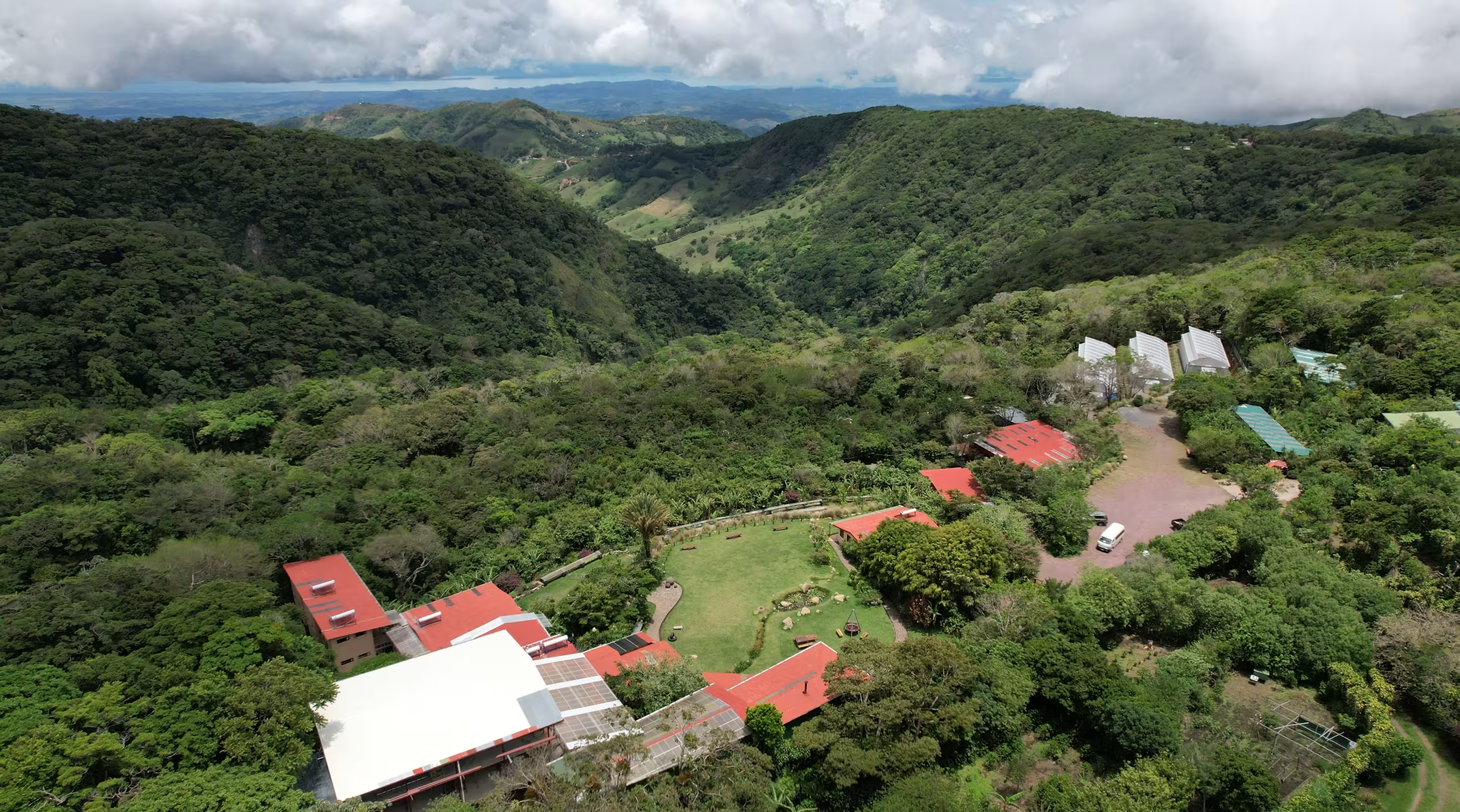
Valle Escondido sits at the transition between these zones—clouds literally move through the property, creating exceptionally productive microclimate. For a PDC student learning to design in complex microclimate, reading gradients, observing how conditions change with altitude and aspect—this specificity and subtlety gives designers major edge in understanding how to work with landscape conditions. The ability to read subtle environmental variation becomes embedded through observation of real, visible, dramatic changes in vegetation and conditions across small distances.
How Cultural Immersion Deepens Permaculture Learning
Permaculture includes explicit principles for community design and cultural adaptation. Its third ethic—Fair Share—involves questions about how benefits are distributed and how systems serve communities. Learning permaculture in your home culture, surrounded by your own assumptions and frameworks, makes some of these lessons invisible. Spending time in a different culture, with different approaches to land, food, and community, makes cultural learning tangible.
The Permaculture Design Certificate at Valle Escondido brings together participants from across Central and North America, Europe, and beyond—sometimes from South America, Asia, or Australia. This diversity enriches every design conversation. You're not learning permaculture in a homogeneous group of similar people; you're learning alongside farmers from Honduras, architects from Canada, land managers from Chile, teachers from the U.S. The diversity of perspective, experience, and approach deepens understanding for everyone.
Learning from practitioners with direct experience in tropical systems—how Costa Rican soils actually behave, how the rainy season affects design and management, how traditional agricultural knowledge from the region intersects with permaculture principles—adds practical depth that no generic international course can provide. You're not reading about tropical systems; you're learning from people who live and work in them daily.
The Valle Escondido Difference
Valle Escondido is not a demonstration site built for educational theater. It's a functioning 17-hectare farm continuously developed and managed for over a decade, supporting residents, producing food, maintaining habitat, and operating as a real business. The systems you study in the PDC are the same systems producing food, managing water, and supporting the property today—not theoretical examples, but active reality.
Instructors are the people who designed and manage the farm. Their expertise is embodied in the landscape around you. When an instructor talks about why trees are positioned where they are, or how a particular swale was designed to handle the exact rainfall patterns of this elevation, they're not referencing a textbook—they're discussing decisions they made years ago and observing consequences today. Every walk is a teaching moment from people who built what you're walking through.
This creates a transparency about real permaculture practice that's rare. You see both successes and failures. Some swales work better than others. Some plant choices flourish while others struggle. Rather than polished case studies, you're observing real adaptive management—systems continuously adjusted based on observation and experience. This honesty about what actually works (and what doesn't) is more educational than idealized examples.
Learning from real adaptive management—with visible successes and failures—teaches more than idealized case studies ever could.
From Certificate to Practice: What Graduates Do
Valle Escondido PDC graduates pursue diverse paths with their certification and learning. Some design and manage their own farms or homesteads across Latin America, North America, and Europe—implementing permaculture principles in their home contexts. Others work as permaculture consultants for farms, estates, development projects, and organizations wanting to integrate ecological thinking into their land management.
Some establish community gardens and urban food production systems in their home cities, bringing permaculture thinking to urban contexts. Some teach permaculture in their own communities, extending the reach of the principles. Some integrate permaculture into professional work in architecture, landscape design, urban planning, or international development—applying the frameworks to problems beyond agriculture.
Many return to Valle Escondido as interns, volunteers, or assistant instructors—deepening their own practice while contributing to the farm and teaching next cohorts. The certificate isn't an ending; it's a beginning. What graduates do afterward—across decades—is diverse, but consistently rooted in the principles and practices learned in the PDC.
Is It the Right Time for You?
A residential Permaculture Design Certificate in Latin America is a significant commitment of time, money, and attention. It's worth being clear-eyed about what it entails and whether it aligns with where you are. You're likely ready if: you have a clear sense of why you want the certificate and what you'll do with it afterward; you're prepared to engage fully with a demanding immersive program; you're genuinely curious about working with land, ecology, and systems design as a long-term practice, not a temporary escape.
If you're uncertain, that's useful information. The first step isn't a sales call. A real conversation about your situation, goals, and whether this program makes sense for where you are is the right starting place. That conversation can happen through the contact page or by scheduling a free 30-minute call with one of the Valle Escondido instructors. They can help you assess whether a PDC now is right, what alternative paths might serve you better, and what to expect if you do enroll.
Learning permaculture in a tropical cloud forest, embedded in functioning systems, surrounded by exceptional biodiversity, and taught by practitioners with deep experience in this specific context, is an irreplaceable educational opportunity. But it's most valuable if you're genuinely ready for it, clear about your intentions, and prepared to engage fully with the learning. If that describes you, we'd be delighted to have that conversation. Contact us at edu@avercr.org or reach out through the contact page on the homepage.