Why Water Design Comes First
In permaculture, water occupies a privileged position in the design hierarchy—before planting, before building infrastructure, before almost any other decision on the land. This isn't arbitrary. Water is the foundation upon which everything else is built. Without it, soil degrades, plants fail, and ecosystems collapse. With it managed well, the entire property becomes more resilient, more productive, and requires less external input.
Land that loses water quickly bleeds nutrients and microbial life with every rainfall. When water rushes across a slope rather than infiltrating, it carries away the most precious resource on any property: topsoil. The organic matter, minerals, and living organisms that took centuries to develop disappear in a single heavy rain. The result is a vicious cycle of degradation—less soil holds less water, which means less plant growth, which means less organic matter, which means harder, more compacted soil that sheds water even faster.
Land that captures and infiltrates water, by contrast, builds resilience. The water table rises. Springs that have run dry recharge. Soils become structurally stable and biologically active. Microbial networks thrive. Plants develop deeper roots and greater drought tolerance. An ecosystem that was in retreat begins to recover. This transformation doesn't happen overnight, but it happens reliably—and water management is the leverage point that makes it possible.
Reading Your Land Before You Design
The first step in any water harvesting system is observation. This means spending time on your land during different conditions—especially during heavy rain. Walk the property and notice where water collects, where it runs off rapidly, and where it seems to disappear into the ground. Pay attention to which areas stay soggy weeks after rain and which dry out within days. Look for signs of existing water movement: erosion gullies, compacted paths where water has flowed repeatedly, areas where certain plants thrive (which often indicates consistent moisture).
Ask yourself key questions: Where does water enter the property? At which elevation, from which direction? Where does water exit? Does it concentrate at a single point or spread across multiple outflows? Where does water pool or accumulate? Are there natural low points, swales, or drainage channels? Where is soil consistently moist even in the dry season? These observations will reveal the water story of your land—the patterns that have been running for years, regardless of what you plan to do. The best designs work with these patterns rather than fighting them.
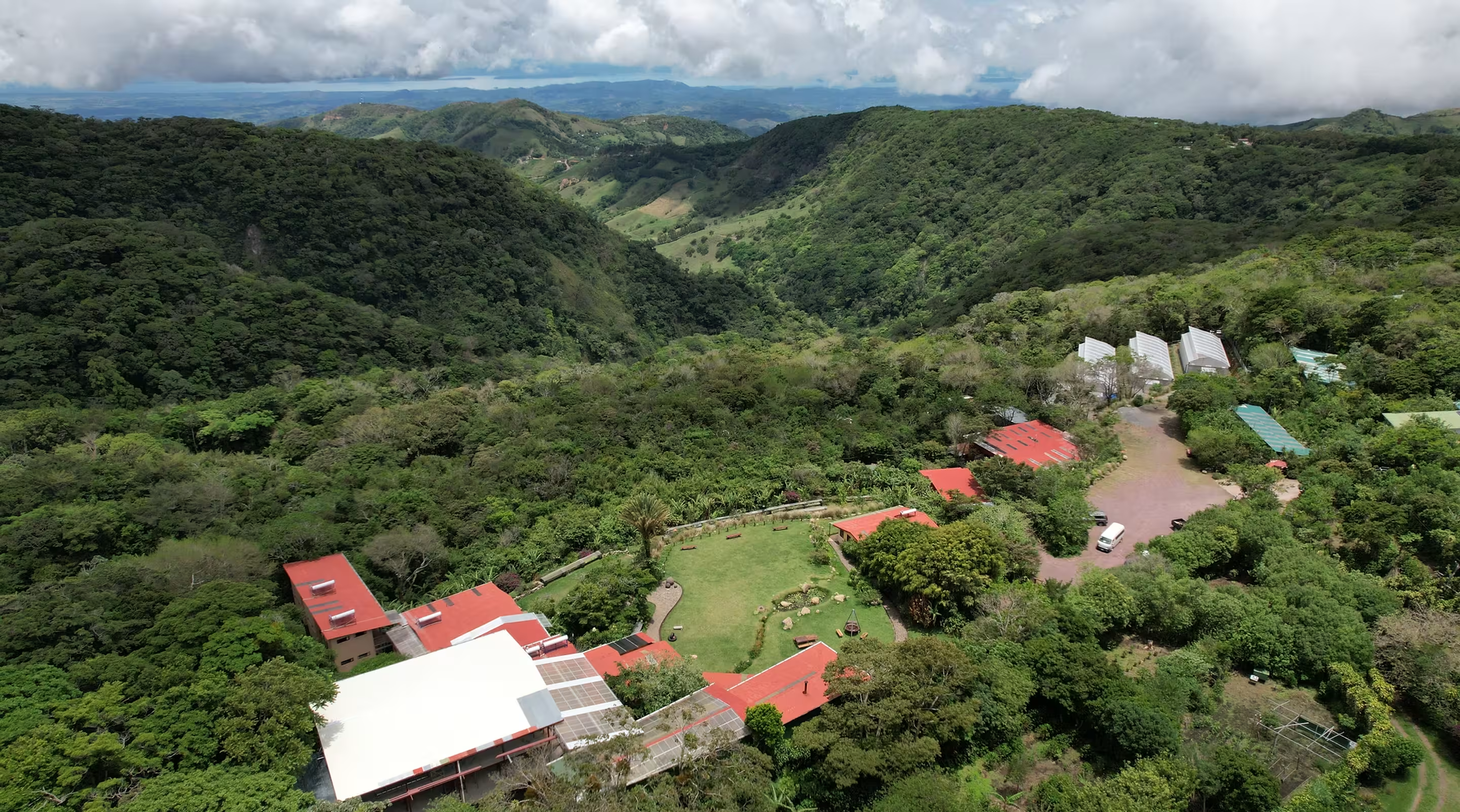
A simple tool can accelerate this reading: a bunyip level (also called a water level or sight level) allows you to map the contours of your land and identify ideal locations for swales, ponds, and other water-harvesting structures. Walking the land with contour lines in hand reveals where water will naturally flow and where it will want to stop. At Valle Escondido, early observation revealed that water was moving across slopes far too quickly, carrying away topsoil and preventing infiltration. Rather than installing drainage systems to move water away faster, the solution was to intercept it—a series of swales designed to slow and spread water across the hillside.
Swales: The Backbone of Any Water Harvesting System
A swale is one of the most powerful and fundamental tools in permaculture water harvesting. At its simplest, a swale is a level trench dug on contour—meaning it follows the same elevation around a slope, neither rising nor falling. This simplicity is precisely what makes it so effective. Because the swale is level, any water that enters it spreads evenly along its length rather than concentrating at one end. The water then infiltrates the ground below, creating what permaculturists call a "water lens"—a zone of consistent, sustained moisture that extends downslope from the swale's berm.
The mechanics are straightforward but powerful. When rain hits a slope, it wants to run downhill following gravity. A swale intercepts this water and forces it to stop, spread out, and soak in. On the upslope side of the swale is the ditch (usually 30-60 centimeters deep). On the downslope side is a ridge of soil called the berm, created from excavating the ditch. Trees planted on the berm tap into the water lens below the ditch; their roots reach down into permanently moist soil even during dry seasons. The overflow from a swale doesn't stop there—excess water cascades to the next swale downslope, creating a gentle staircase of water interception across the hillside.
At Valle Escondido, swales were installed across the property early in its development. Today, the mature trees planted on those berms are thriving with minimal supplemental irrigation, even during periods when rain is sparse. The visible difference between areas with swales and areas without is striking: vegetation is lusher, trees are larger, and the soil is darker and more alive. This wasn't achieved through irrigation systems or expensive infrastructure—just gravity, contour, and patience.
Rainwater Collection: Tanks, Rooftops, and Catchment Areas
While swales and ponds capture water across the landscape, rooftop rainwater collection is one of the most efficient and immediately practical water harvesting systems available. Every roof is a catchment area waiting to be used. A house, barn, or other structure with a clean metal or tile roof can collect hundreds or thousands of liters of rain annually—water that would otherwise run off as waste.
A basic rooftop system is surprisingly simple: clean roof surface plus gutters with leaf guards, feeding into a first-flush diverter (which captures the first minutes of rain, removing accumulated dust and debris), which then directs cleaner water into a storage tank. Before using the water for drinking or cooking, basic filtration—a simple sand and gravel filter, or even a clean cloth—removes particles and makes the water clear. The whole system can be built with readily available materials and basic carpentry.
The math is compelling. A 100-square-meter roof in a region receiving 2,000 millimeters of annual rainfall can collect approximately 200,000 liters per year—enough to supply a household's water needs for several months and fully irrigate a kitchen garden for the entire year. Scale this to a larger building, or multiple buildings, and the volume becomes enormous. Water that once posed a problem (gutters overflowing, soil erosion around foundations) becomes a resource.
Valle Escondido uses rooftop collection extensively for domestic water needs—drinking, cooking, and washing. Surface catchment ponds serve agricultural and ecological water storage. The combination ensures reliable water for multiple purposes without depending on centralized infrastructure or pumps.
Ponds: Storage, Ecology, and Aquaculture
A well-designed pond is far more than a storage tank for water. It is an ecosystem—a living system that regulates temperature, supports biodiversity, and enables food production through aquaculture. In permaculture design, ponds serve multiple functions simultaneously: water storage for dry season irrigation, habitat for aquatic life, fire-suppression infrastructure, stock watering, and increasingly, food production.
Valle Escondido's clay-lined ponds are stocked with tilapia—a hardy fish that thrives in tropical climates, produces excellent protein, and tolerates the variable water quality that comes with greywater input. Fish waste enriches the water with nutrients; duckweed and other aquatic plants feed on these nutrients and provide supplemental fish food; when ponds are partially drained for maintenance, the nutrient-rich sediment is transferred directly to garden beds where it acts as a powerful fertilizer. The entire system cycles nutrients rather than losing them.
Designing a productive pond requires attention to several principles: locate it in a natural low point to minimize excavation and work with gravity; if the soil is sandy, seal the bottom and sides with bentonite to prevent excessive seepage; design an overflow outlet with a level spillway to prevent breaching during large rain events; create shelved margins that allow shallow zones for aquatic plants and wildlife; plant the upslope berm with nitrogen-fixing trees and other species that won't shade the water excessively but will stabilize the banks and provide leaf litter to feed the system.
Ponds also function as critical fire-suppression infrastructure—increasingly important in regions where dry seasons intensify. A 50-square-meter pond holds 250,000 liters of water available to fight fire. This function alone justifies the investment in many regions.
Constructed Wetlands: Turning Greywater Into a Resource
Most properties generate "greywater"—water from kitchens, bathrooms, and washing areas. This water contains organic matter, nutrients, and bacteria, making it unsuitable for drinking but perfectly suitable for irrigation once cleaned. A constructed wetland is a system that processes greywater through planted channels, removing nutrients and pathogens, and producing water clean enough to irrigate fruit trees and gardens.
The system is elegantly simple in concept: greywater enters planted basins filled with gravel and clay barriers; wetland plants (cattails, vetiver grass, heliconia, and others) extract nutrients from the water; soil microorganisms and biofilms on gravel surfaces break down organic matter and pathogens; clean water exits from the far end. The plants themselves do some of the filtering work, but the real purification happens in the soil and microbial communities—the same processes that clean water in natural wetlands, now captured and used on-site.
The beauty of this approach is that greywater—a disposal problem in conventional systems—becomes a resource. At Valle Escondido, the constructed wetland eliminates the need for a conventional septic system while simultaneously producing irrigation water for a significant portion of the garden. No pumps, no chemicals, no electricity required. The system operates entirely by gravity, powered by rain and supplemented by the structure of the earthwork itself.
Gravity-Fed Irrigation: Designing Without Pumps
In hilly terrain, water stored in an upper pond or elevated tank can distribute downslope to all lower areas entirely by gravity—no pumps, no electricity, no ongoing operational costs. This is one of the greatest advantages of hillside permaculture design: the topography does the work. Water wants to flow downhill; we simply capture it higher and let it flow where we need it.
Valle Escondido distributes water from upper ponds and tanks to lower growing areas entirely by gravity. The main line runs downslope, with secondary lines branching off to different zones. At each branching point, simple shut-off valves allow directing water to specific areas. From the main lines, slow-flow drip irrigation delivers water directly to plant roots, reducing waste and ensuring efficient use.
Designing a successful gravity system requires several key decisions: the water source must be elevated enough to create adequate pressure (roughly one meter of elevation creates enough pressure for drip lines in a typical system); main lines should be sized appropriately for the water volume—too small and pressure drops, too large and the system becomes expensive; pipes must be protected from ultraviolet light (PVC degrades rapidly in sunlight; burying lines or using UV-resistant material is essential); a sediment filter at the outlet prevents debris from clogging drip lines; and shut-off valves and pressure regulators allow fine-tuning the system for different crops and seasons.
Common Mistakes in Water Harvesting
Building swales off-contour is one of the most common and destructive mistakes. A swale that isn't truly level will funnel water toward the end that is lowest in elevation, concentrating water at a single point. This concentration causes erosion at that point, undermining the entire purpose of the swale. A simple level and patience during construction prevents this—it's the difference between a system that functions well for decades and one that becomes a liability.
Building water harvesting infrastructure too small is another frequent error. A single swale, a single pond, or a single tank might meet water needs during an average year. But the system must be sized for the dry season and for variability. If your dry season lasts four months and requires 50,000 liters of water for household and irrigation use, your storage capacity needs to approach that level. Most water harvesting systems benefit from redundancy—multiple ponds rather than one, multiple catchment areas rather than a single rooftop.
Ignoring overflow is a dangerous oversight. Every pond and every swale needs a designed overflow path. When a large rain event occurs—heavier than usual—water will accumulate faster than it can infiltrate. Without a designed overflow, this water will eventually breach the earthwork, potentially washing away years of construction and causing damage. The overflow should be gentle, stabilized with planted materials, and designed to cascade to the next structure downslope.
Planting shallow-rooted annual vegetables on swale berms is another mistake. These shallow roots can't reach the water lens below the ditch; the plants compete for whatever moisture is in the berm itself. Instead, use deep-rooted perennials—especially nitrogen-fixing trees like Inga species, acacia, or pigeon pea. These trees develop extensive root systems that reach the permanent moisture zone and provide annual leaf litter that improves the soil.
Not testing for clay content before digging a pond can be costly. Sandy soils drain water too quickly and require expensive sealing with clay or bentonite. A simple test—digging a hole, filling it with water, and observing how long it takes to drain—reveals whether your soil will hold a pond or simply become an expensive hole in the ground. If drainage is too fast, sealing is necessary; if it's appropriate, your pond will work beautifully.
Starting Small: Your First Water Harvesting Project
The best first project is one you can complete in a season and learn from immediately. Start with a single on-contour swale, 5 to 10 meters long, dug at a location where you've observed water movement during rain. Plant the berm with nitrogen-fixing shrubs and fruit trees. In one rainy season, you'll observe how the swale fills, how water infiltrates, and how the moisture pattern changes downslope. One functional swale teaches more than any textbook about how water moves on your land.
This observation-based approach is central to permaculture design. You learn by building, testing, and observing. Does the swale stay full? Does it dry out? Where exactly is the water lens of consistent moisture? Which trees thrive on the berm? This direct feedback shapes your next projects—you know, from lived experience rather than theory, how your particular land, climate, and soil work.
Valle Escondido PDC students survey land, map contours, design water systems from first principles, and sometimes build a real swale together. The combination of classroom learning and hands-on construction creates understanding that lasts. For a broader framework behind all of this, read the article on permaculture principles—or learn more about the Permaculture Design Certificate on the homepage, where you can combine theory and practice in a comprehensive way.